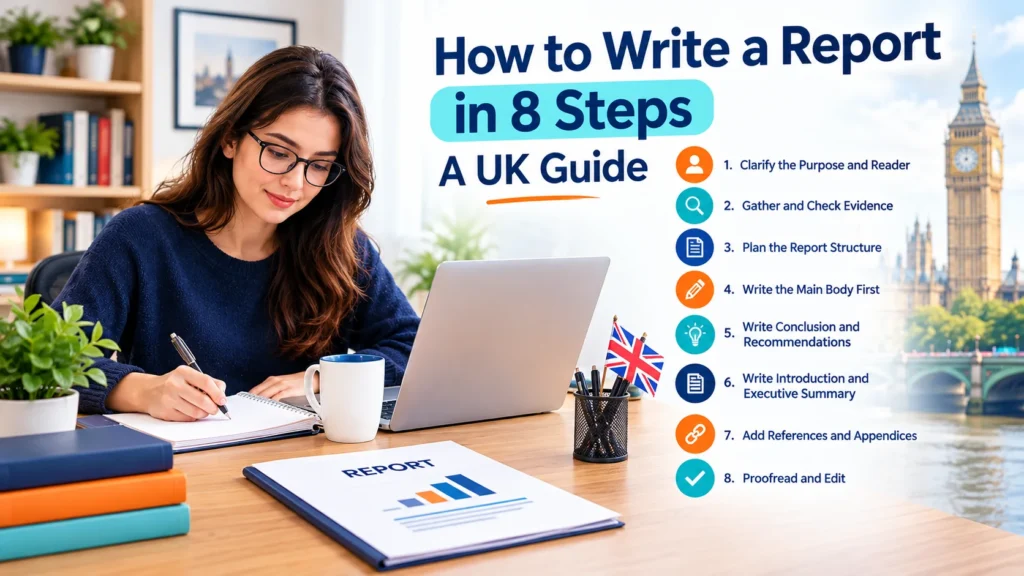
Knowing how to write a report comes down to one idea: give a specific reader the facts, what those facts mean and a clear next step, in a structure they can scan quickly. Reports are used at university and at work, and the best ones are planned before the first sentence is written. This report writing guide shows how to write a report step by step, with a clear report structure, worked report writing examples and a checklist for the final edit.
Formats vary between universities, employers and subjects, so always follow your brief, template or house style first. Where this guide offers a suggestion rather than a rule, it says so.
Key takeaways
- Work out who the report is for and what it should help them decide or do.
- Plan the sections first, then write the main body before the introduction and executive summary.
- Make every recommendation specific, realistic and linked to a finding.
- Choose a style that suits your reader, then edit for clarity before you submit or send.
What Is a Report, and How Is It Different From an Essay?
A report presents information, analysis and, in most cases, recommendations for a particular audience. Leeds Beckett University’s Skills for Learning guide explains that, unlike essays, reports present information, analysis and recommendations rather than addressing a question or debate, and that their format varies with course requirements. The University of Portsmouth Library sets out the practical differences, which are summarised below.
| Feature | Report | Essay |
|---|---|---|
| Layout | Divided into headed sections | Continuous text with no section headings |
| Visuals | May include tables, charts and diagrams | Do not usually include them |
| Methods | May describe how the data was collected | Do not focus much on research methods |
| Recommendations | Usually included | Not included |
| Content | Often presents findings and analysis from research | Focuses on analysing or evaluating theory and ideas |
It also helps to know which kind of report you are writing. Leeds Beckett advises checking whether your assignment needs an academic report or a business or professional one. Professional reports usually outline a situation and propose actions, with limited reference to academic literature, while most university reports need published sources and proper citation. Common types include:
- Lab and science reports, which may follow the IMRaD pattern (introduction, methods, results and discussion).
- Business or client reports, which investigate a problem and recommend action.
- Dissertations, which Leeds Beckett describes as a specialised type of report.
How to Write a Report in 8 Steps
These eight steps suit most business reports and taught-course reports. Lab reports and dissertations often have extra requirements, so check your department’s guidance first.
The 8 steps at a glance
1Clarify the Purpose, Reader and Brief
Before you research anything, complete this sentence: “This report will help [reader] to [understand, decide or act on] [topic].” That sentence becomes your test for what stays in and what goes out.
Next, check the practical limits: word count, deadline, required sections, referencing style, and whether you need an executive summary or contents page. The University of Nottingham’s guide to business reports describes a business report as a document that summarises an investigation and sets out recommendations for decision-makers, so think about what those decision-makers already know and how much time they have.
Quick tip: if you can, ask whoever commissioned the report which decision it should support. If you cannot ask, state your assumption in the introduction so the reader knows how you interpreted the brief.
2Gather and Check Your Evidence
Collect only the evidence that serves your purpose. Note the source of each fact as you go, so your reference list is easy to build later. Keep facts separate from your interpretation of them, and say plainly where the evidence is limited.
If you gathered your own data, such as survey answers, interviews or website analytics, explain how you collected it and why you chose that method. Nottingham advises including a methodology when you have gathered new data, so that someone else could understand and repeat what you did.
3Plan Your Report Structure
If you are unsure how to structure a report, start from the usual report writing format. The table below shows common sections, what each one does and a suggested point to write it. Treat it as a menu rather than a requirement: Nottingham’s guide lists up to 15 possible sections, including acknowledgements, abbreviations and background, and your brief may rename, merge or drop some of them.
| Section | What it does | Suggested time to write it |
|---|---|---|
| Title page | Gives the title and any details your brief requires | Early |
| Executive summary | Summarises what was investigated, how, what was found and what is recommended | Last |
| Contents page | Lists sections and page numbers, if required | Once headings are final |
| Introduction | States the purpose, context, aims and objectives, and defines key terms | After the findings are clear |
| Main body (methodology, findings and analysis, discussion) | Presents and interprets the evidence in themed sections | First |
| Conclusion | Sums up the key findings against the aims, with no new information | After the main body |
| Recommendations | Lists specific, realistic actions that follow from the findings, in order of importance | After the conclusion |
| References and bibliography | Lists every source you cited, in the required style | As you go |
| Appendices | Holds optional supporting material that would interrupt the main text | As needed |
Readers meet the executive summary first, but you will usually write it last. Nottingham also suggests writing the introduction towards the end, or re-reading and editing it once the discussion is finished. The diagram shows how the reading order differs from a practical drafting order.
Quick tip: use your word processor’s heading styles from the start. Leeds Beckett recommends generating the contents page automatically from your headings, and Aberystwyth advises using one numbering system consistently throughout. If you like to sketch headings before drafting, our blog post outline template for beginners and free Blog Outline Generator show the same outline-first habit for articles, and the idea adapts easily to reports.
4Write the Main Body First
The main body is where the analysis happens, so start here. Divide it into sections that each cover one theme. The Portsmouth guide suggests aiming for roughly 8 to 10 lines per section and splitting a section that runs longer. Use headings that make sense on their own: “Why late enquiries go unanswered” tells the reader far more than “Enquiries”.
Within each section, state the finding first and explain what it means straight after. Label and number any tables and charts, and move long raw data, such as questionnaires, to an appendix with a short summary in the main text, as Leeds Beckett advises.
Give the discussion extra care. Leeds Beckett calls it the most important part of a report, because it is where you interpret the findings and draw conclusions. Structure it around the themes or trends that emerge rather than repeating the results one by one.
Scan test: Nottingham suggests imagining that your manager walks into a meeting having only skimmed the report. If they read just your headings, tables and charts, could they still pick up the key results?
5Write the Conclusion and Recommendations
Learning how to write a report conclusion is mostly about restraint. Return to the aims you set in the introduction, summarise the key findings and add no new information. Leeds Beckett adds a useful test: a reader should be able to grasp the major issues from the conclusion alone. Nottingham describes it as a “bottom-heavy” summary that also reminds the reader of the key recommendations.
Portsmouth describes good recommendations as specific, realistic suggestions that follow directly from your findings, listed in order of importance, and it suggests testing each one: is it achievable, and is it already happening? Nottingham adds that they should be clear, brief and actionable, often as bullet points, and that you can group them by who should act, such as the client, the company or future investigators.
Compare these two report writing examples of the same recommendation:
- Vague: Improve how enquiries are handled.
- Specific: Assign one team member to check the shared inbox every morning and reply to all enquiries within one working day.
6Write the Introduction and Executive Summary
If you are wondering how to start a report, begin with the purpose. The introduction should state why the report exists, give brief context, set out the aims and objectives, and define any key terms.
Guidance differs here. Portsmouth says to keep results and recommendations out of the introduction, whereas Leeds Beckett suggests closing it with a brief indication of your findings and conclusions. Follow your own department’s guidance, and if you are unsure, a single signposting sentence about what follows is a safe middle route.
Here is a short report introduction example you can adapt (illustrative):
This report reviews how customer enquiries were handled by the sales team over the last six months. It aims to identify the main causes of delayed replies and to recommend practical changes. The analysis draws on inbox records and short staff interviews, and it covers email enquiries only.
The executive summary does a different job. It is not an introduction: it tells the reader what the report found, covering what was investigated, how, what was found and what is recommended. York St John University’s executive summary factsheet describes it as a concise overview that lets the reader judge whether the full report is worth reading, and it says to write it after the main report is finished. Guidance on length differs between institutions, so follow your brief:
| Source | Length guidance |
|---|---|
| University of Portsmouth | About 100 to 250 words, with one or two sentences on each section |
| University of Nottingham | One to three sentences for each main section of the report |
| Aberystwyth University | Around 10% of the length of the whole report |
| York St John University | Within a single page |
7Add References and Appendices
List every source you cited, in the referencing style your institution or employer requires. Appendices are optional. Use them for supporting material that would interrupt the main text, such as interview transcripts, surveys or questionnaires, as Aberystwyth University’s business report guide suggests. Number or letter each one and refer to it in the text, for example “(Appendix 1)” or “See Appendix B”.
8Proofread and Edit
Step away from the draft before you edit, then check in layers: content and structure first, then clarity, then spelling, grammar and formatting. Confirm that headings are consistent, that figures and tables are numbered, and that every appendix is mentioned in the text. Read the executive summary again at the end to confirm that it still matches the final report. The style tips and checklist below show what to look for.
Report Writing Examples You Can Adapt
Seeing a complete skeleton makes the report writing format easier to follow. The three examples below use an imaginary business report and are for illustration only. The details are invented, so replace them with your own evidence.
Example 1: outline of a short business report
Title: Reducing Delays in Replying to Customer Enquiries
- Executive summary
- Introduction (purpose, scope, aims)
- Methodology (inbox records and short staff interviews)
- Findings and analysis (when and why replies are delayed)
- Discussion (what the delays mean for the sales team)
- Conclusion
- Recommendations
- References
- Appendix 1: raw response-time data
Example 2: a short executive summary
This report examines why some customer email enquiries receive late replies. It reviewed six months of inbox records and drew on short staff interviews. Enquiries received late in the day were most likely to be delayed because nobody was responsible for checking the inbox at closing time. The report recommends naming a daily inbox owner and setting a target of replying within one working day.
Example 3: ordered recommendations
- Name one team member as the daily inbox owner, starting next month.
- Set a target of replying to every enquiry within one working day.
- Review response times monthly for the first quarter and report the results to the sales manager.
Published reports also make good models. York St John’s factsheet points students to the executive summaries in published CIPD reports as examples of how professionals do it.
Report Writing Tips for a Clear, Professional Style
- Match your style to the reader. Leeds Beckett advises academic reports to use formal English and the third person, and to avoid contractions and first-person pronouns. A workplace report for busy managers often reads better in plainer language, so check what your reader expects.
- Use plain English where you can. GOV.UK’s clear language guidance makes plain English mandatory and notes that people with higher literacy levels prefer it because they understand the information faster. Explain technical terms the first time you use them.
- Be concise, professional and direct. Leeds Beckett also notes that report writers typically use cautious language. For example, “the data suggest” is safer than “the data prove” when the evidence is limited.
- Use passive voice deliberately. The same GOV.UK guidance points out that passive voice can create long sentences that are harder to read, yet some academic guides, including Leeds Beckett’s, show third-person phrasing such as “A survey was conducted”. Our guide on how to reduce passive voice in writing explains when to keep it, and the Passive Voice Checker shows where it is piling up.
- Cut padding. Run your draft through the Filler Word Checker to spot words that add length but not meaning.
- Check readability. Our Readability Checker shows words, sentences, syllables and average words per sentence, which helps you find overlong sentences.
- Write a clear title and consistent headings. Test title options with the Headline Analyzer, and use the Case Converter to keep heading capitalisation consistent.
- Respect the limit. Use the Word Counter to check your length before you submit.
Report Writing Checklist
Use this report writing checklist for your final read-through:
- ✔ The purpose is clear in one sentence, and you know who the reader is.
- ✔ Every section your brief requires is present and in the required order.
- ✔ Each main-body section covers one theme and has a self-explanatory heading.
- ✔ Claims are backed by evidence, and sources are referenced in the required style.
- ✔ The conclusion contains no new information.
- ✔ Each recommendation is specific, realistic and traceable to a finding.
- ✔ The executive summary matches the finished report.
- ✔ Tables, figures and appendices are numbered and referred to in the text.
- ✔ Spelling, grammar and formatting are consistent, and the word count is within the limit.
- ✔ Someone else can tell you, in their own words, what the report asks the reader to do.
For another example of checking in stages, see our website copywriting checklist for small business, which splits its checks into before, during and after writing.
Common Mistakes When Writing a Report
- Starting to write before the brief and the reader are clear.
- Treating the executive summary as a second introduction.
- Writing the executive summary first and forgetting to update it.
- Giving vague recommendations that nobody can act on.
- Placing raw data in the main body instead of an appendix.
- Introducing new information in the conclusion.
- Skipping the edit because the deadline is close.
Frequently Asked Questions
How long should a report be?
There is no universal length. It depends on your brief, your purpose and your reader. Follow any word limit you have been given, and keep each section focused on one theme.
How long should an executive summary be?
Institutions give different guidance, from 100 to 250 words to around 10% of the report or a single page, as the table in Step 6 shows. Follow the brief you have been given.
Do I always need an executive summary?
No. Business reports commonly include one, and some assignments do not require it. Check your brief, and if you do write one, write it last.
What is the difference between a report and an essay?
A report uses headed sections, may include tables and charts, and usually ends with recommendations. An essay presents an argument in continuous text and does not usually include recommendations.
Should recommendations be bullet points?
They can be. Nottingham notes that recommendations can be written as paragraphs but are often shown as bullet points. Choose whichever makes each action clearest, and follow any format your brief sets.
Can I use AI to help me write a report?
First check what your employer or institution allows. Leeds Beckett, for example, points students to separate guidance on permissible uses of AI. If AI support is permitted, treat it as a helper, verify every fact and source yourself, and read our guide to AI writing tools for what they can and cannot do well.
Final Thoughts
To recap how to write a report: understand the reader, gather and check your evidence, plan the structure, write the main body first, turn your findings into specific recommendations, and write the introduction and executive summary once the substance is settled. Then edit hard.
Your next steps
- Run your draft through the Readability Checker and the Passive Voice Checker.
- Brush up on clear, reader-focused writing with our copywriting guide for beginners.
- Want to share the findings beyond the report itself? Our content repurposing guide shows how to adapt one strong piece into several formats.
- Explore all of our free writing tools when you are ready to polish the final version.

- I’m Saba Sheikh, a self-employed copywriter and SEO content writer specializing in website copy, landing pages, SEO blog writing, product descriptions, and email copywriting. I create search-optimized, conversion-focused content that helps startups, small businesses, and eCommerce brands grow their online presence and attract more customers.