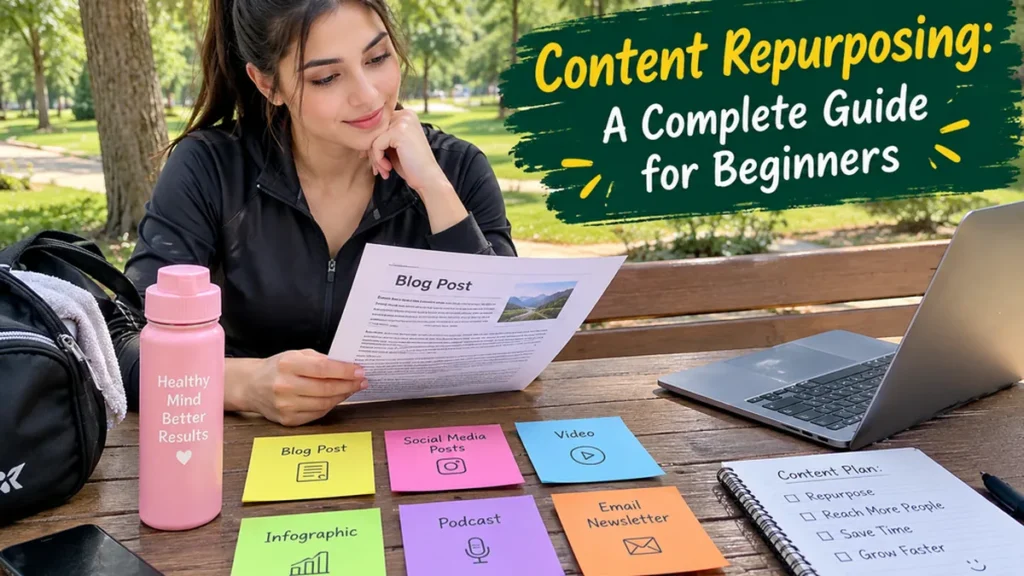
Content repurposing is how experienced content teams get more mileage out of every piece they create, instead of treating each blog post, video, or guide as a one-and-done project. This guide covers what it actually involves, how to do it well across different formats, and where AI genuinely helps without producing generic, low-effort output.
What Is Content Repurposing?
Content repurposing means taking one piece of existing content and adapting it into different formats or channels, rather than creating everything from scratch every time. A single in-depth blog post might become a short video script, a handful of social posts, an email newsletter section, and an infographic—all from research and writing you’ve already done once.
It’s different from simply reposting the same content everywhere unchanged. Effective content repurposing adapts the format, length, and tone to fit each platform, rather than copy-pasting the same text across channels where it doesn’t actually fit. A LinkedIn audience reads differently than an Instagram audience, and a repurposed piece that ignores that distinction tends to underperform on both.
Why Content Repurposing Matters
Producing original content from scratch takes real time—research, writing, editing, and design all add up. Content repurposing stretches that investment further, reaching audiences on platforms they actually use without multiplying the research and drafting work each time.
It also serves people differently based on how they consume information. Some prefer reading a full guide; others want a two-minute video or a quick social summary. Repurposing the same core idea across formats means you’re not limiting a piece of content’s reach to whoever happens to prefer its original format.
There’s a compounding effect too. A well-researched pillar piece that gets repurposed six or seven times over its lifespan generates far more total reach than a piece published once and left untouched, without requiring six or seven times the original effort. This is part of why content repurposing has become a standing part of most mature content strategies rather than an occasional afterthought.
The 1-to-Many Content Method
The most efficient approach to content repurposing treats one substantial “pillar” piece as the source material for everything else—sometimes called the 1-to-many method. Instead of planning ten separate pieces of content, you plan one comprehensive piece, then extract ten smaller assets from it.
A single well-researched guide on, say, keyword research—our own Keyword Research guide is a good example—can realistically become a checklist graphic, a short explainer video, three or four social posts covering individual sections, and an email breaking down one key tip. The heavy lifting—research and core writing—happens once, and everything downstream becomes an adaptation rather than a fresh project.
This method also naturally reinforces topical authority, since every repurposed piece links back to the original, more comprehensive resource, the same way our guide on Content Marketing Strategy connects to the more specific pieces built around it.

How to Repurpose a Blog Post
A blog post is usually the easiest starting point for repurposing, since it typically already contains structured sections, examples, and a logical flow. Practical ways to repurpose one:
- Turn each H2 section into a standalone social post or carousel slide
- Convert a step-by-step section into a checklist or downloadable PDF
- Extract a strong statistic or quote into a shareable graphic
- Expand the post’s core argument into a script for a short video
- Summarize the entire post into a concise email newsletter section
If the original post’s headline didn’t perform as well as expected, running a few alternative angles through our Headline Analyzer before repurposing it can help you lead with a stronger hook the second time around. It’s also worth revisiting the post’s meta description at this stage—our Meta Description Generator can help draft a fresher summary if the repurposing effort coincides with an update to the original page.
How to Repurpose Video Content
Video repurposing usually works in the opposite direction from blog repurposing—breaking one longer asset down into smaller, platform-specific pieces rather than expanding outward. A single long-form video can become:
- Short vertical clips highlighting individual key moments
- A full written transcript, lightly edited into a blog post
- Audio-only extraction for a podcast feed
- Quote graphics pulled from specific statements made in the video
The written transcript route is particularly efficient for SEO purposes, since it gives you a text-based asset that can be optimized and indexed, something the video itself can’t do on its own. According to HubSpot’s ongoing research on content marketing trends, short-form video consistently ranks among the highest-engagement formats marketers report, which makes video-to-clip repurposing one of the more consistently worthwhile investments in this list.
How to Repurpose Content for Social Media
Social repurposing requires more than shrinking the same message down—each platform has different norms around tone, length, and format. A blog post’s key statistic might work as a simple graphic on Instagram, a short thread on X, and a more detailed carousel post on LinkedIn, even though the underlying insight is identical across all three.
Tools like Buffer are commonly used to plan and schedule this kind of repurposed content across multiple platforms from a single source piece, which keeps the workflow manageable rather than requiring separate planning for each channel. Spacing out publication—rather than releasing every repurposed asset the same day the original goes live—also tends to extend a single piece’s visible lifespan across a longer window.

Content Repurposing Examples
| Original Format | Repurposed Into |
|---|---|
| Long-form blog guide | Checklist graphic, email series, social carousel |
| Webinar recording | Blog post transcript, short clips, quote graphics |
| Case study | LinkedIn post, sales one-pager, email testimonial |
| Podcast episode | Blog summary, audiogram clips, quote tweets |
| Customer FAQ responses | FAQ blog section, help center article, social Q&A post |
| Product launch announcement | Press-style blog post, email blast, social teaser series |
These examples aren’t exhaustive, but they illustrate the underlying pattern: one solid piece of original thinking, adapted repeatedly rather than recreated from zero each time. The specific formats matter less than the discipline of always asking, before publishing something new, whether it could double as source material for something else later.
AI Content Repurposing
AI tools have made content repurposing noticeably fastfaster—generatingst-draft social captions from a blog post, summarizing a video transcript, or drafting an email based on existing content are all tasks AI handles reasonably well as a starting point. Our earlier guide on AI Content Marketing covers this kind of AI-assisted workflow in more depth, and the same caution applies here: Unedited AI output tends toward generic phrasing that doesn’t hold up well across a platform where tone and specificity matter, like a personal social account.
The safest approach treats AI as a drafting accelerator for repurposed formats, with a human pass afterward to add platform-specific tone, correct anything AI oversimplified, and make sure the repurposed piece still sounds like your brand rather than a generic summary. If you’re testing AI-assisted writing tools as part of this workflow, our guide on AI Writing Tools breaks down which tasks they handle well and where editing still matters most. For ChatGPT specifically, since it’s increasingly a channel where repurposed summaries and citations can surface content, our guide on How to Rank Your Website in ChatGPT is worth reviewing alongside your repurposing workflow.
Common Mistakes to Avoid
- Copy-pasting identical content across platforms without adjusting tone or format
- Repurposing weak original content, which just multiplies a problem instead of solving it
- Publishing everything at once, rather than spacing repurposed pieces out over time
- Skipping the original source’s context, leaving repurposed pieces confusing on their own
- Relying entirely on unedited AI output, producing generic content across every channel
- Forgetting to link repurposed pieces back to the original, missing an easy source of referral traffic and topical reinforcement
According to Search Engine Journal, one of the more common reasons repurposed content underperforms isn’t the repurposing itself but a failure to adapt the original keyword targeting to match how each platform’s audience actually searches or browses—a short-form video caption needs different phrasing than a long-form blog title, even when covering the same underlying topic.
A Simple Content Repurposing Workflow
- Choose a strong-performing or comprehensive original piece
- Identify its distinct subtopics, key stats, or standout moments
- Match each subtopic to the platform and format best suited to it
- Draft each repurposed piece, using AI for speed where useful
- Edit for platform-specific tone and add relevant calls to action
- Schedule and space out publishing rather than releasing everything at once
- Track engagement to see which repurposed formats perform best going forward
If a repurposed piece includes a specific action you want the reader to take—signing up, clicking through, replying—testing that call-to-action through our CTA Generator helps ensure it’s clear and compelling rather than an afterthought tacked onto the end. And if a repurposed piece is being rebuilt around a slightly different keyword angle than the original, our Keyword Generator can help confirm the new angle still has genuine search demand before you invest time drafting it.
This kind of repeatable process fits naturally into a broader Content Marketing Strategy, where repurposing becomes a standing part of the content calendar rather than an occasional afterthought.
FAQs
What is content repurposing?
Adapting one piece of existing content into different formats or platforms, rather than creating entirely new content from scratch each time.
What’s the easiest content to repurpose first?
A comprehensive blog post is usually the easiest starting point, since it already contains structured sections and examples to draw from.
Can AI help with content repurposing?
Yes, particularly for first-draft social captions, summaries, and transcripts, though human editing still matters for tone and platform fit.
How often should I repurpose content?
There’s no fixed rule, but treating repurposing as a standing step in your content workflow — rather than an occasional extra task — tends to produce more consistent results.
Does repurposed content hurt SEO through duplication?
Not when it’s genuinely adapted rather than copy-pasted identically across your own domain; different formats and platforms don’t typically create duplicate content issues.
Should every piece of content be repurposed?
Not necessarily — repurposing works best on genuinely strong, comprehensive original pieces rather than weaker content that wouldn’t perform well in any format.
Conclusion
Content repurposing isn’t about squeezing more output for its own sake — it’s about making sure genuinely good content actually reaches the different audiences and platforms where it could help. Starting with one strong original piece, mapping out where its sub-topics naturally fit across formats, and building a simple repeatable workflow around that turns content repurposing from an occasional afterthought into a real, compounding efficiency gain in your content process.

- I’m Saba Sheikh, a self-employed copywriter and SEO content writer specializing in website copy, landing pages, SEO blog writing, product descriptions, and email copywriting. I create search-optimized, conversion-focused content that helps startups, small businesses, and eCommerce brands grow their online presence and attract more customers.