A website gets a reasonable amount of traffic every week, but almost everyone leaves without subscribing to anything. That’s a different problem from “not enough traffic”—it”‘s a conversion problem, and learning how to get more email subscribers means treating it as one. This guide covers the full path: understanding why subscribers matter more than raw traffic, building an offer worth signing up for, placing signup forms where they actually convert, and following up in a way that keeps subscribers engaged rather than immediately unsubscribing.
1.How to Get More Email Subscribers: Why They Matter More Than Traffic Alone
A website visitor is a one-time interaction unless something brings them back. An email subscriber is different—it’s permission to reach that person directly, on a channel you control, without depending on a platform’s algorithm to resurface your content.
This matters because traffic alone doesn’t build a relationship. Email lets you distribute useful content directly, nurture people who aren’t ready to buy or commit yet, and create repeated opportunities for engagement that a single visit never offers. None of this guarantees sales—an email list is a relationship to maintain responsibly, not an asset that belongs to a business regardless of what subscribers actually want from it.
2. Understand What Your Target Audience Actually Wants
Before building a signup offer, get specific about what your actual audience struggles with or wants to learn. Reviewing your best-performing content, the questions readers leave in comments, and recurring themes in customer support conversations usually reveals more accurate signals than guessing.
This connects directly to understanding real search behavior—our guide on Keyword Research: A Complete Guide for Beginners covers how to validate what your audience is actually searching for, which often points directly toward what kind of lead magnet would genuinely interest them.
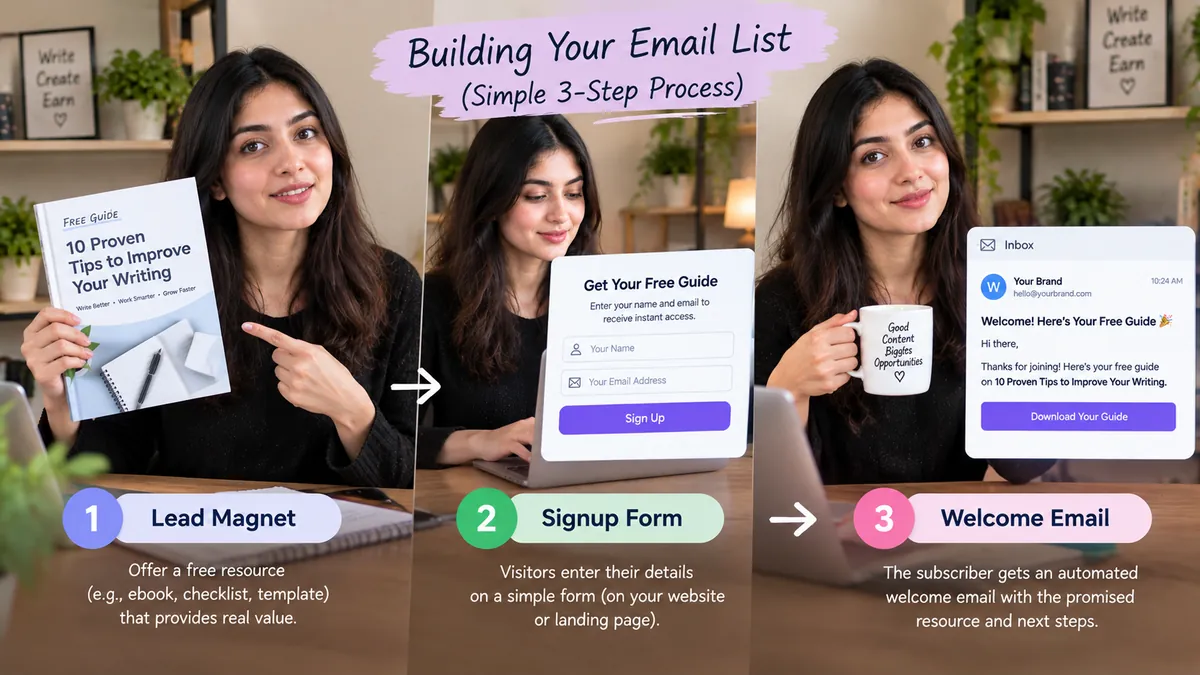
3. Create a Lead Magnet Worth Signing Up For
A lead magnet works best when it solves one specific, narrow problem rather than offering something vague. Effective formats include:
- Checklists—quick, actionable reference material
- Templates—ready-to-use structures that save the reader time
- Short guides—focused explainers on a single topic
- Worksheets—interactive tools for working through a specific task
- Resource lists—curated collections of useful tools or links
- Free tools or calculators—genuinely useful utilities
- Mini-courses—a short email series teaching one skill
A focused offer—”a 10-point SEO audit checklist”—is easier for a visitor to understand and value than a vague “subscribe to our newsletter” invitation, which asks for a commitment without explaining what’s actually in it for the reader.
4. Place Signup Forms Where They Fit Naturally
Where a signup form appears matters as much as what it offers. Relevant placements include within blog posts (especially near content that directly relates to the offer), on the homepage, on a dedicated landing page built specifically for the offer, in the header or footer for persistent visibility, in a sidebar where relevant, and as in-content calls to action placed naturally within an article’s flow.
Mobile usability matters here specifically—a form that’s easy to dismiss accidentally or difficult to fill out on a small screen loses signups regardless of how strong the offer is.
5. Use Content Upgrades to Convert Blog Readers
A content upgrade connects a specific article to a closely related subscriber offer, rather than offering the same generic incentive across every page. For example, a keyword research article paired with a keyword research checklist, an SEO copywriting article paired with a copywriting checklist, or a content marketing article paired with a content planning template.
Our own Content Marketing Strategy: A Complete Guide for Beginners illustrates this logic—a reader deep in a strategy guide is a strong candidate for a related planning template offer, since the offer matches exactly what they’re already trying to accomplish.
6. Use Popups Carefully
Exit-intent popups, scroll-triggered popups, and time-delayed popups are all common approaches, each with different tradeoffs. Exit-intent popups appear as a visitor is about to leave, scroll-based popups trigger after meaningful engagement with the page, and time-based popups appear after a set delay regardless of behavior.
None of these guarantees improved conversion—a poorly timed or overly aggressive popup can just as easily frustrate visitors and increase bounce rate. Mobile usability, dismissal ease, and reasonable frequency (not showing the same popup repeatedly to the same visitor) all matter for keeping the experience from feeling intrusive.
7. Make the Signup Form Simple and Clear
A high-converting signup form typically includes a specific headline (not “Subscribe to our newsletter,” but something describing the actual offer), a clear value proposition explaining what the subscriber gets, minimal required fields (usually just an email address), one clear call to action, mobile-friendly design, and clear expectations about what kind of emails and how often they’ll receive them.
Asking for unnecessary information—name, company, phone number—at the signup stage tends to reduce conversion without adding meaningful value for most use cases.
8. Turn SEO Traffic Into Email Subscribers
Organic search traffic represents one of the most sustainable subscriber sources, following a consistent pathway: a relevant search query leads to a helpful article, which offers a relevant content upgrade, which leads to a signup form, a welcome email, and ongoing useful communication.
This only works when the traffic itself is relevant—a large volume of visitors arriving for an unrelated query rarely converts into genuinely interested subscribers, regardless of how strong the signup offer is. Our guide on How to Rank Your Website in ChatGPT: A Complete Guide is relevant here too, since AI-driven search traffic is an increasingly real source worth factoring into this same pathway.
9. Promote Your Signup Offer Beyond Your Website
Social media profiles, educational posts, short videos, relevant online communities, and creator collaborations all offer ways to point people toward a specific, valuable offer rather than just repeatedly asking people to “subscribe” with no explanation of why. Our guide on Content Repurposing: A Complete Guide covers how one strong lead magnet or related piece of content can be adapted into multiple promotional formats across channels, rather than creating separate promotional content from scratch for each platform.
10. Create a Useful Welcome Email Sequence
A realistic example of a welcome sequence looks like this:
- Email 1—Deliver the promised resource immediately
- Email 2—Introduce the brand and set expectations for future emails
- Email 3—Share a useful lesson or closely related resource
- Email 4—Address a common problem your audience faces
- Email 5—Introduce a relevant offer or resource, where genuinely appropriate
This is an example structure, not a mandatory formula—the right sequence length and content depend on your specific audience and what you’re actually offering.
11. Segment Your Subscribers for More Relevant Emails
Segmentation means grouping subscribers based on interests, which lead magnets they downloaded, how they signed up, or preferences they’ve explicitly stated, so future emails feel more relevant to each group rather than generic to the entire list.
Mailchimp’s guidance on email list segmentation covers practical segmentation approaches in more technical depth. Relevance generally improves the subscriber experience, though specific performance gains vary too much by list and industry to state as a fixed, universal figure.
12. Measure Email List Growth and Improve Results
| Metric | What It Tells You |
|---|---|
| New subscribers | Raw growth rate over a given period |
| Signup conversion rate | How effectively visitors convert into subscribers |
| Landing page performance | Whether your dedicated signup page is working |
| Signup source | Which channels are actually driving subscribers |
| Lead magnet downloads | Which offers resonate most with visitors |
| Unsubscribe rate | Whether your emails are meeting subscriber expectations |
| Email engagement | Whether subscribers are actually opening and acting on emails |
Raw subscriber count alone doesn’t tell you whether a list is healthy—a smaller, engaged list that opens and acts on emails is generally more valuable than a large, disengaged one.
13. Common Email List-Building Mistakes
- Buying email lists—a practice that violates permission-based marketing principles and typically produces poor engagement
- Using vague signup offers that don’t clearly explain their value
- Asking for unnecessary information at signup, reducing conversion
- Hiding signup forms where visitors are unlikely to notice them
- Showing excessive popups that frustrate rather than convert
- Offering irrelevant lead magnets that don’t match the content a visitor is actually reading
- Ignoring mobile users, where a meaningful share of traffic now originates
- Sending emails without proper permission, risking both trust and legal compliance
- Failing to meet subscriber expectations set during signup
- Neglecting list hygiene, leaving inactive or bounced addresses unaddressed
- Focusing on quantity over relevance, chasing subscriber count rather than genuine engagement
Permission-based marketing matters here specifically—the FTC’s CAN-SPAM compliance guidance outlines US requirements, while the UK ICO’s direct marketing guidance covers equivalent expectations under UK law—rules differ by jurisdiction, so checking the relevant official guidance for your specific market matters more than assuming one standard applies everywhere.
14. A Practical 30-Day Email Subscriber Growth Plan
- Week 1—Research your audience’s actual problems and select one focused, useful lead magnet
- Week 2 — Build a simple landing page and add relevant signup forms across your site
- Week 3 — Add content upgrades to your best-performing articles and promote the offer across channels
- Week 4 — Set up a basic welcome sequence, review early performance data, and improve the weakest step in the process
This plan is realistic for a solo creator or small website — it doesn’t assume a dedicated marketing team or significant budget, just focused, sequential effort over four weeks.
Frequently Asked Questions
How can I get more email subscribers?
Create a specific, valuable lead magnet, place signup forms where they genuinely fit your content, and promote the offer consistently across channels your audience already uses.
How do I get my first 100 email subscribers?
Start with one focused offer promoted directly to your existing audience — social followers, blog readers, or professional contacts — rather than relying solely on passive signup forms early on.
What is the best way to grow an email list?
There’s no single universal answer, but pairing genuinely useful content with a closely related, specific offer tends to outperform generic “subscribe to our newsletter” prompts.
How do I get email subscribers from my website?
Place relevant signup forms within your content, especially tied to specific articles through content upgrades, and ensure your forms are simple, mobile-friendly, and clearly communicate their value.
What makes a good lead magnet?
A good lead magnet solves one specific, narrow problem clearly and quickly, rather than offering something vague or overly broad.
Do popups help grow an email list?
They can, but results vary significantly based on timing, design, and frequency — a poorly implemented popup can hurt user experience rather than help conversion.
How often should I email my subscribers?
This depends on your audience and content volume — consistency and relevance generally matter more than a specific fixed frequency.
Can SEO help me get more email subscribers?
Yes, when organic traffic is genuinely relevant to your offer — irrelevant traffic, regardless of volume, tends to convert poorly into subscribers.
Conclusion
Growing an email list comes down to a consistent sequence: understand your actual audience, build one genuinely useful offer, place signup forms where they naturally fit, follow up with a welcome sequence that delivers real value, and keep refining based on what the data actually shows. There’s no guaranteed subscriber count or timeline — but starting with one focused audience, one useful lead magnet, and one clear signup path is a realistic, repeatable way to build real momentum.

- I’m Saba Sheikh, a self-employed copywriter and SEO content writer specializing in website copy, landing pages, SEO blog writing, product descriptions, and email copywriting. I create search-optimized, conversion-focused content that helps startups, small businesses, and eCommerce brands grow their online presence and attract more customers.