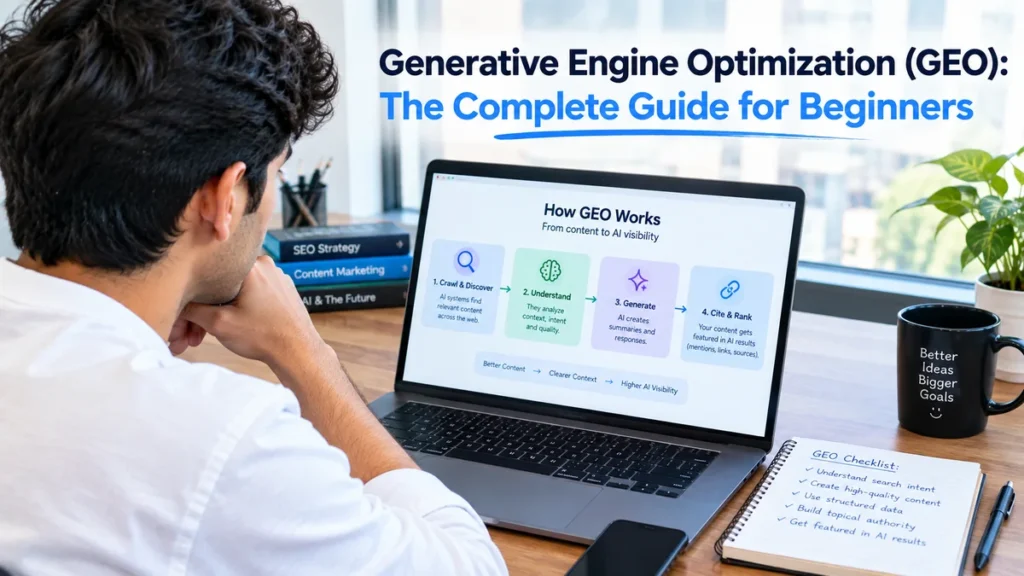
If you’ve noticed AI tools like ChatGPT and Perplexity answering questions directly instead of sending users to a results page, you’ve already seen why generative engine optimization has become a term worth understanding. GEO is the practice of structuring content so these AI systems cite, quote, or recommend it when generating an answer—a distinct discipline from traditional SEO, though built on many of the same fundamentals. This guide covers what GEO actually means, how it works, and how to start applying it without falling for exaggerated claims about guaranteed results.
What Is Generative Engine Optimization?
Generative engine optimization is the practice of structuring digital content so that generative AI engines—systems that synthesize answers from multiple sources rather than returning a ranked list of links—cite, quote, or recommend that content when responding to a user’s question. The term covers optimization for tools like ChatGPT, Perplexity, and Google’s AI Overviews, all of which generate a direct answer instead of a traditional results page.
The distinction that matters most: traditional search asks, “Where does this page rank?” while GEO asks, “Does this page get used in the answer at all?” Those are genuinely different questions, and they call for a partly different approach.
How Is GEO Different From Traditional SEO?
SEO and GEO share the same foundation—content needs to be crawlable, well-structured, and genuinely useful either way. Where they diverge is the end goal and some of the tactics used to get there.
| Factor | Traditional SEO | Generative Engine Optimization |
|---|---|---|
| Primary goal | Rank in a list of search results | Get cited or quoted in a generated answer. |
| Success signal | Position on a results page | Presence and accuracy within an AI answer |
| Content shape | Optimized for ranking and click-through | Optimized for direct extraction and citation |
| Technical focus | Page speed, mobile usability, crawlability | Structured data, entity clarity, answer-ready formatting |
| Measurement | Rank tracking, CTR, organic traffic | Citation tracking, AI referral traffic, brand mentions |
Neither replaces the other. GEO builds on SEO fundamentals rather than discarding them.
How Generative Engines Actually Work
A generative engine is any system that uses a large language model to retrieve information from multiple sources and synthesize it into a single answer, rather than displaying a list of links for the user to choose from. When a generative engine responds to a query, it typically retrieves a handful of relevant pages, extracts the information most directly relevant to the question, and blends it into a coherent response—often with inline citations pointing back to the original sources.
This retrieval-and-synthesis process is why content structure matters so much for Generative Engine Optimization: a system pulling a direct answer favors content that states that answer clearly and early, rather than content the reader has to dig through several paragraphs to find.

Why GEO Matters for Website Owners
As more people turn to AI tools for quick answers, some portion of search-driven discovery is shifting away from traditional results pages and toward these synthesized responses. For website owners, bloggers, and businesses relying on organic visibility, that means a growing share of potential audience interactions happen through citation in an AI answer rather than a traditional click-through.
This doesn’t mean traditional SEO is becoming irrelevant—it remains the larger and more established channel. But treating Generative Engine Optimization as a genuinely separate consideration, rather than assuming good SEO automatically covers it, is a reasonable position for any site that wants to stay visible as search behavior continues to evolve.
Core Principles of Generative Engine Optimization
A few principles show up consistently across credible GEO guidance:
- Answer clearly and early. State the direct answer to a likely question near the top of a section, before adding supporting detail.
- Write in clear, well-structured language. Generative engines extract information more reliably from clean, well-organized content than from dense, meandering prose.
- Back claims with specifics. Verifiable facts, data points, and clear sourcing make content more citable than vague generalizations.
- Build genuine topical depth. A single isolated page competes less effectively than a site demonstrating consistent expertise across a subject.
- Maintain accuracy over time. Outdated information is a liability for both traditional rankings and AI citation.
How to Structure Content for GEO
Structure isn’t just a readability nicety here—it’s the function of how generative engines extract usable information. Effective structure includes a clear H1 describing the page’s core topic, logical H2/H3 subheadings that describe exactly what each section covers, short paragraphs instead of dense blocks, bullet points and numbered lists for grouped or sequential information, tables for direct comparisons, and FAQ sections pairing a specific question with a direct, self-contained answer.
Headlines matter more here than many writers assume, since a clear, specific headline signals exactly what a section answers before an AI system even parses the body text. Running your page titles through our Headline Analyzer before publishing helps confirm a headline states its core topic clearly rather than relying on cleverness alone.
The Role of Content Marketing in GEO
Generative engine optimization doesn’t exist in isolation from a broader content strategy—it’s most effective layered on top of a genuine content marketing approach that already prioritizes usefulness and originality. Our earlier guide, AI Content Marketing, covers how AI tools fit into research, planning, and content creation more broadly, and that foundation matters directly here: content built primarily to manipulate visibility, whether for traditional search or generative engines, tends to underperform both.
Using AI Writing Tools Responsibly Within a GEO Strategy
AI writing tools can meaningfully speed up drafting and structuring content for GEO, but the same caution that applies to AI-assisted content generally applies here too—unedited AI output tends toward generic phrasing that doesn’t stand out as a citable source. Our guide on AI Writing Tools scours this balance in more depth, including where AI genuinely helps and where human editing remains essential.
If you’re refining a page’s core message before restructuring it for GEO, our Value Proposition Generator can help sharpen the specific, concrete statement a generative engine would actually want to extract and cite, rather than a vague description that could apply to any competitor.
GEO and ChatGPT Visibility
ChatGPT is one of the most prominent generative engines, and visibility within it deserves specific attention. Our dedicated guide, How to Rank Your Website in ChatGPT, goes deeper into ChatGPT’s citation behavior specifically, including how its search feature retrieves and selects sources. The core Generative Engine Optimization principles in this article apply directly to that guide’s recommendations—structured, answer-first, genuinely useful content is the common thread across every generative engine, not just ChatGPT specifically.
Entity Recognition and Structured Data
Generative engines rely partly on recognizing entities—people, brands, products, and organizations—consistently across the web to build confidence in a source’s credibility. Consistent naming of your brand, author, and key topics across your site and any external profiles helps reinforce this recognition. Structured data markup (schema.org formats for articles, FAQs, and organizations) gives AI systems and traditional search engines alike a clearer, machine-readable signal about what a page contains, beyond what they’d infer from plain text alone.
Building Topical Authority for GEO
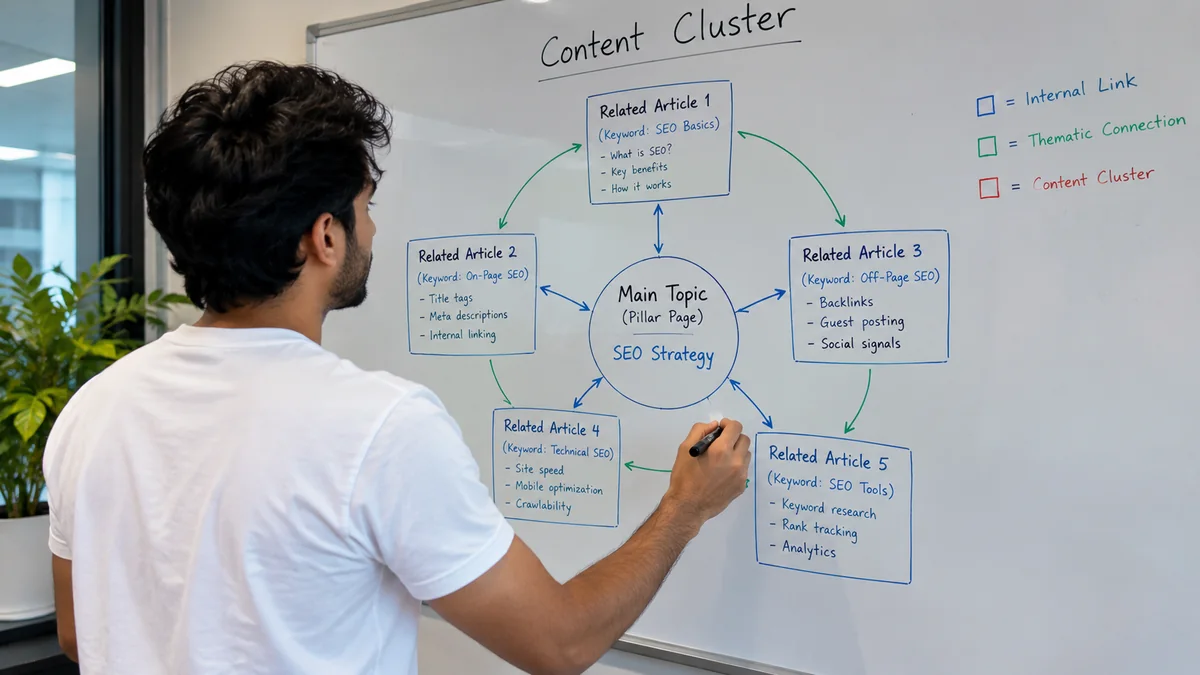
Topical authority—demonstrating comprehensive, connected expertise on a subject rather than one isolated page—matters as much for GEO as it does for traditional SEO, arguably more, since generative engines synthesizing an answer tend to favor sources that show consistent depth across a topic. A content cluster like the one this article extends—covering AI content marketing, AI writing tools, ChatGPT visibility, and now GEO itself—builds exactly this kind of connected authority, with each piece reinforcing the others through genuine, contextual internal linking.
Common GEO Mistakes to Avoid
A few mistakes undermine Generative Engine Optimization efforts consistently, and most of them come down to prioritizing shortcuts over genuine content quality.
- Burying the answer deep in a paragraph instead of stating it clearly near the top
- Keyword stuffing in an attempt to force relevance, which reads poorly to both humans and AI systems
- Publishing thin, unedited AI-generated content with no added expertise or verification
- Ignoring technical fundamentals—a page a crawler can’t access won’t get cited regardless of how well it’s written
- Chasing GEO while abandoning SEO fundamentals, since the two remain deeply connected
- Making unverifiable claims, which undermines the accuracy generative engines and readers both rely on
GEO vs SEO vs AEO
A related term, Answer Engine Optimization (AEO), often gets used alongside GEO, and the overlap causes some confusion. AEO generally refers to optimizing for direct-answer features like featured snippets and voice search results, while GEO specifically targets generative AI engines synthesizing multi-source answers. In practice, the tactics overlap significantly—clear structure, direct answers, and verifiable claims serve all three disciplines. Treating them as three lenses on the same underlying goal, rather than three separate strategies, tends to be the more practical approach.
Step-by-Step GEO Strategy for Beginners
- Audit existing content for clarity, structure, and how directly it answers likely questions
- Identify core topics where your site can demonstrate genuine, connected depth
- Rewrite key pages to state direct answers early, supported by specific, verifiable detail
- Add clean structural elements — headings, lists, tables, FAQs — throughout
- Strengthen internal linking across related content to reinforce topical authority
- Confirm technical fundamentals — crawlability, indexability, page speed, mobile usability
- Build genuine external mentions and authority through real outreach, not manipulative tactics
- Keep key pages updated as information changes
- Test relevant queries manually against ChatGPT and other generative engines to check for citations
- Refine based on what content types actually earn citations over time
This kind of structural discipline matters regardless of the platform your content lives on — whether you publish through WordPress, Blogger, or a custom CMS, the underlying principles of clear structure and genuine usefulness apply the same way.
How to Measure GEO Performance
There’s no single universal metric for Generative Engine Optimization performance yet, comparable to rank tracking in traditional SEO, but a few realistic approaches exist.: monitoring referral traffic from AI platforms where your analytics identify it, manually testing relevant queries across generative engines to check for citations, using mention-tracking tools to catch citations that don’t generate direct traffic, and watching for indirect signals like increased branded search volume.
Independent research from outlets like Search Engine Land regularly tracks how AI citation patterns shift as underlying models change, which is a useful way to stay current on broader trends even without a perfect internal metric.
Keyword and content research still plays a role in shaping GEO strategy the same way it does for traditional SEO — identifying the specific questions your audience is actually asking. Our Keyword Generator can help surface natural-language question variations worth building content around, and once a page is drafted, testing meta descriptions through our Meta Description Generator ensures the summary a search or AI system sees first accurately reflects the page’s core answer. For pages meant to drive a specific action alongside informational value, our CTA Generator helps make sure GEO-focused restructuring doesn’t come at the cost of conversions.
Backlink and mention monitoring through platforms like Ahrefs or Semrush remains useful here too, since genuine external authority signals continue to factor into how both traditional search engines and generative AI systems judge source credibility. For broader context on how Google’s own systems evaluate content quality regardless of production method, Google Search Central remains the most reliable primary source.
Key Takeaways
- Generative Engine Optimization is the practice of structuring content so AI engines like ChatGPT and Perplexity cite or recommend it in generated answers
- GEO builds on traditional SEO fundamentals rather than replacing them
- Clear, answer-first structure and verifiable specifics matter more here than exact keyword matching
- Topical authority and genuine content depth strengthen GEO outcomes significantly
- No tool or service can guarantee citation in any specific AI-generated answer
- Measuring GEO performance currently requires a mix of manual testing, referral tracking, and mention monitoring
FAQs
What is Generative Engine Optimization?
It’s the practice of structuring content so generative AI engines like ChatGPT and Perplexity cite, quote, or recommend it when generating answers to user questions.
How is GEO different from SEO?
SEO focuses on ranking in a list of search results; GEO focuses on being included in a synthesized AI-generated answer. They share many of the same underlying fundamentals.
Can GEO guarantee my content gets cited by ChatGPT or other AI tools?
No. No legitimate strategy or service can guarantee a specific citation outcome in any generative engine.
Is GEO the same as AEO?
They’re closely related but not identical — AEO typically targets direct-answer features like featured snippets, while GEO specifically targets generative AI engines synthesizing multi-source answers.
Do I need to abandon traditional SEO to focus on GEO?
No. GEO builds directly on traditional SEO fundamentals; the two work best together, not as competing strategies.
Does content structure really matter for AI citation?
Yes — generative engines extract information more reliably from clearly structured, answer-first content than from dense, unstructured prose.
Can AI-generated content perform well for GEO?
Yes, if it’s accurate, well-edited, and genuinely useful. As with traditional SEO, content quality matters more than the production method.
How do I measure whether my GEO efforts are working?
Track referral traffic from AI platforms where identifiable, manually test relevant queries, monitor brand mentions, and watch for indirect signals like branded search growth.
Does GEO work the same way across every generative AI tool?
The core principles — clear structure, verifiable claims, genuine authority — apply broadly, though each platform’s specific retrieval and citation behavior can differ somewhat.
Is GEO worth prioritizing for a small business website?
It can be, particularly alongside existing SEO efforts, since the underlying content quality improvements benefit both traditional and AI-driven visibility.
Conclusion
Generative Engine Optimization isn’t a replacement for SEO — it’s a natural extension of the same underlying goal: creating genuinely useful, well-structured, trustworthy content that a system (human search engine or AI model) can confidently surface. Starting with clear, answer-first structure, genuine topical depth, and accurate, verifiable content gives any site a reasonable foundation for GEO, without relying on shortcuts or guaranteed-result promises that no one can actually deliver.

- I’m Saba Sheikh, a self-employed copywriter and SEO content writer specializing in website copy, landing pages, SEO blog writing, product descriptions, and email copywriting. I create search-optimized, conversion-focused content that helps startups, small businesses, and eCommerce brands grow their online presence and attract more customers.