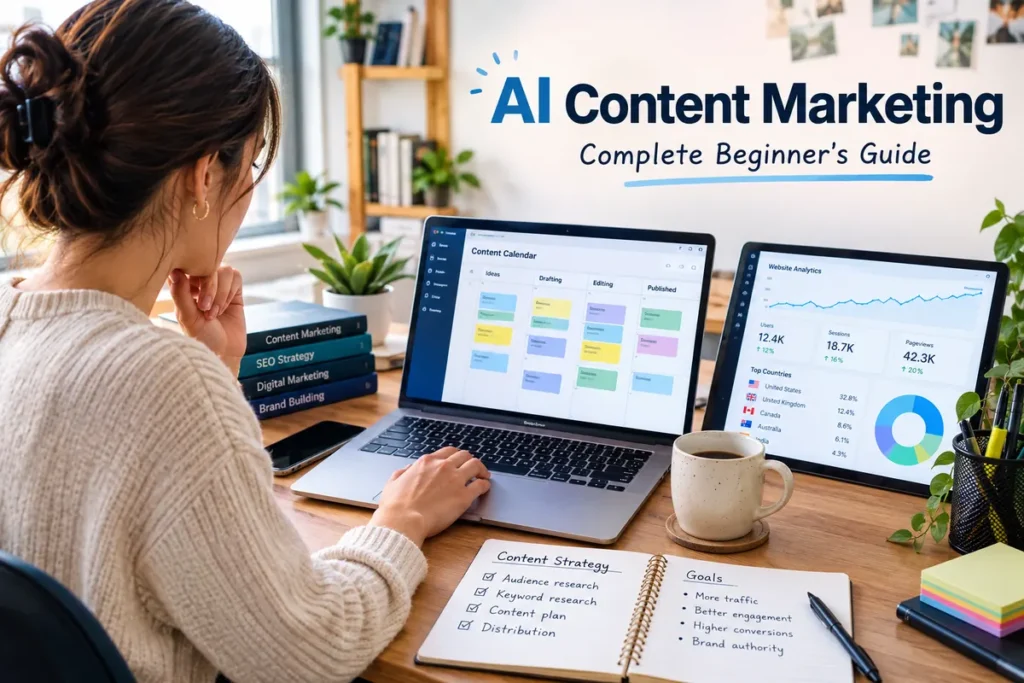
If you’ve searched for AI content marketing hoping for a straight answer about whether it actually works, you’re not alone—and the honest answer is more useful than a simple yes or no. AI content marketing isn’t one tool or one shortcut. It’s a shift in how research, drafting, and optimization get done, with human judgment still deciding what actually gets published. This guide walks through what that looks like in practice, without the exaggerated claims that usually surround the topic.
What Is AI Content Marketing?
AI content marketing is the use of artificial intelligence tools to support content strategy, research, creation, and optimization—while humans still direct the strategy and approve the final output. It covers a wide range of tasks: generating topic ideas, drafting outlines, writing first drafts, suggesting headlines, analyzing SEO data, and even personalizing content for different audience segments.
It’s worth being precise here, because the term gets used loosely. AI content marketing is not the same as publishing unedited AI output at scale. It’s a workflow where generative AI handles the repetitive, time-consuming parts of content production, and human expertise handles judgment, accuracy, and originality—the parts AI genuinely can’t replace yet.
How AI Content Marketing Works
In practice, AI tools plug into specific stages of the content process rather than replacing the process entirely. A typical AI-assisted workflow touches:
- Research—summarizing existing articles, identifying content gaps, and surfacing questions real audiences are asking
- Planning—clustering related topics, suggesting content calendars, and mapping keywords to search intent
- Drafting—generating a first-pass structure or rough draft based on a brief
- Optimization—suggesting improvements to headlines, meta descriptions, and on-page structure
- Distribution—repurposing one piece of content into multiple formats (social posts, email snippets, video scripts)
None of these steps eliminates the need for a human editor to fact-check claims, add real examples, and make sure the final piece actually reflects the brand’s voice and expertise.
Why AI Content Marketing Matters
Content teams are under more pressure than ever to publish consistently while competition for search visibility keeps increasing. AI content marketing matters because it changes the economics of that pressure—a solo blogger or small marketing team can now research and draft in a fraction of the time it used to take, freeing up hours for the parts of content that actually require human insight: original analysis, first-hand experience, and editorial judgment.
This matters just as much for search visibility as it does for productivity. Google has been direct about this: its ranking systems are built to reward original, high-quality content regardless of how it was produced, and its guidance explicitly states that AI-generated content fits into the company’s long-standing approach to showing helpful content to people on Search. The tool used to produce content isn’t the deciding factor. What the content actually delivers to the reader is. google
Benefits of AI Content Marketing
Used well, AI content marketing offers a few concrete advantages:
- Speed—first drafts, outlines, and research summaries that used to take hours now take minutes
- Consistency—easier to maintain a regular publishing schedule without burning out a small team
- Data-driven insight—AI tools can process search and performance data far faster than manual analysis
- Scalable personalization—tailoring messaging for different audience segments becomes realistic even for smaller teams
- Lower barrier to entry—beginners without a formal writing background can produce structured, coherent drafts faster
The tradeoff is that none of these benefits show up automatically. They depend on how the tools are used and specifically on whether a human is still shaping the final content with genuine expertise.
How to Create an AI Content Marketing Strategy
A strategy built around AI still starts the same way any content strategy should: with a clear picture of the audience and the business goal behind the content, not with the tools themselves.
1. Define the goal and audience first. Before opening any AI tool, get specific about who the content is for and what action you want them to take after reading it.
2. Audit your existing content. Identify what’s already ranking, what’s underperforming, and where the real content gaps are relative to competitors.
3. Choose where AI adds the most value. For most teams, that’s research, outlining, and first drafts — not final copy that goes live unedited.
4. Build an editorial review step into the workflow. This is non-negotiable. Every AI-assisted draft needs a human pass for accuracy, voice, and added expertise before publishing.
5. Set measurable benchmarks. Decide upfront how you’ll judge whether the AI-assisted approach is actually working—organic traffic, engagement, or conversions, depending on the content’s purpose.
A content marketing strategy built this way treats AI as one input among several, not the whole plan. Google’s own guidance on generative AI states that AI can be useful for researching topics and adding structure to original content, which is a fairly accurate summary of where it fits best in a real strategy. rankai
AI Content Marketing Workflow
Here’s what a realistic, repeatable workflow looks like for a small team or solo content creator:
- Identify the topic and confirm search intent
- Use AI to generate a research summary and outline
- Draft the piece, using AI for structure and first-pass wording
- Add original insight—examples, data, or experience AI can’t produce on its own
- Edit for accuracy, tone, and brand voice
- Optimize on-page elements (headline, meta description, internal links)
- Publish and track performance
This is where a tool like our Headline Analyzer fits naturally—after a draft exists, running the headline through it catches weak or generic phrasing before publishing, something AI-generated headlines are especially prone to without a second pass.
How AI Helps With Keyword Research
Keyword research is one of the areas where AI tools genuinely save meaningful time. Instead of manually brainstorming variations of a topic, AI can quickly surface related terms, question-based searches, and semantic variations that a human might miss on the first pass.
That said, AI-suggested keywords still need validation against real search data before they shape a content plan—search volume and competition data come from actual search engines and SEO platforms, not from an AI model’s training data, which can be outdated or simply wrong about current search behavior. Tools like Semrush and Ahrefs remain the standard for verifying real search volume once AI has helped generate the initial list of candidate terms. If you want a faster starting point for that brainstorming stage, our own Keyword Generator can help build out a first draft of related terms before you validate them.
How AI Helps With Content Planning
Content planning benefits from AI in a similar way to keyword research: it’s good at generating options and structure but less reliable at making final judgment calls. AI can cluster related topics into a content calendar, suggest a logical publishing order based on funnel stage, and flag gaps in existing coverage.
Where human input still matters most in planning is prioritization—deciding which topics actually align with business goals and audience needs, rather than just which topics an AI tool identifies as popular or trending.
How AI Helps With Content Creation
This is the stage most people think of first when they hear “AI content marketing,” and it’s also the stage where quality control matters most. AI is genuinely useful for generating first drafts, rephrasing awkward sentences, and producing variations of a headline or intro to choose from.
It’s considerably less reliable at producing accurate statistics, nuanced arguments, or content that reflects real first-hand experience—the “experience” component of E-E-A-T that Google’s quality guidelines specifically look for. This is the point in the workflow where human editing isn’t optional; it’s what separates content that ranks and builds trust from content that reads as generic.
How AI Helps With SEO
Beyond keyword research, AI tools assist with several practical SEO tasks: suggesting meta descriptions, analyzing readability, identifying internal linking opportunities, and flagging technical issues like missing alt text or thin content sections.
Meta descriptions are a good example of where AI genuinely speeds things up without replacing judgment—generating several options quickly, then having a human pick and refine the one that best matches search intent. Our Meta Description Generator is built for exactly that step, giving you a starting point that still benefits from a manual edit before publishing.
Best AI Content Marketing Tools
Rather than listing every AI tool on the market, it’s more useful to group them by what they actually do well:
- Drafting and writing assistance—general-purpose AI writing tools for first drafts and rephrasing
- SEO and keyword tools—platforms like Semrush and Ahrefs, which combine AI features with verified search data
- On-page optimization—tools focused on headlines, meta descriptions, and readability, including our own free Headline Analyzer, Meta Description Generator, Value Proposition Generator, and CTA Generator
- Analytics and performance tracking—tools that use AI to surface patterns in traffic and engagement data
The right combination depends on team size and where the biggest bottleneck actually is—research, drafting, or optimization.
Human Editing vs. AI-Generated Content
This comparison gets framed as a competition more often than it should. In a functional workflow, it isn’t AI versus humans—it’s AI handling the first 60-70% of the work and humans handling the last, most important 30-40%: accuracy, original insight, and voice.
The risk of skipping human editing isn’t just about quality in the abstract—it’s about accuracy and trust specifically. AI models can generate confident-sounding statements that are factually wrong, a known limitation often called “hallucination.” Human editorial review is what catches this before it reaches readers, and it’s also what adds the first-hand expertise that AI has no way to generate on its own.

Common AI Content Marketing Mistakes
The most common mistakes aren’t really about AI itself—they’re about workflow shortcuts:
- Publishing AI drafts without editing. This is the single biggest driver of thin, generic content that fails to rank or build trust.
- Skipping fact-checking. Treating AI output as automatically accurate leads to embarrassing and damaging errors.
- Scaling content production without adding real value. Producing many pages quickly is only useful if each one genuinely helps a reader; otherwise it risks the kind of scaled content abuse Google’s spam policies specifically address.
- Ignoring brand voice. Unedited AI content tends to sound generic, which erodes the differentiation a brand actually needs.
- Treating AI-suggested keywords as final data. Without validation against real search tools, keyword strategy built purely on AI suggestions can miss the mark entirely.
How to Keep AI Content Helpful and Original
Google has been consistent on this point for years: using automation, including AI, to generate content with the primary purpose of manipulating search rankings violates its spam policies, regardless of the tool involved. The safest approach is straightforward—treat AI as a drafting and research assistant, then make sure every published piece adds something a reader can’t get from a dozen other AI-generated articles on the same topic: a real example, a specific data point, a first-hand observation, or a clearly stated opinion backed by reasoning. google
Originality doesn’t mean avoiding AI. It means making sure the human contribution is substantial enough that the piece would be noticeably worse without it.
How to Measure AI Content Marketing Performance
Traffic data unavailable—connect Google Search Console or Google Analytics to obtain actual country and daily traffic data for content produced under this workflow.
In the absence of live data, the metrics worth tracking for any AI-assisted content program are the same ones that matter for content generally: organic traffic growth over time, average position for target keywords, click-through rate from search results, time on page, and—most importantly for business impact—conversion rate on the specific action the content was meant to drive. Comparing these metrics before and after introducing AI into the workflow is the most reliable way to know whether it’s actually helping.
AI Content Marketing for Small Businesses

Small businesses and solo marketers often benefit the most from AI content marketing, simply because the time savings matter more when there’s no dedicated content team. A small business owner can use AI to draft blog posts, generate product description variations, and create social captions in far less time than doing each manually—as long as someone is still reviewing the output for accuracy and brand fit before it goes live.
The realistic starting point for a small business is narrow: pick one or two content types (blog posts and product pages are common choices), build a simple AI-assisted workflow around those, and expand once the process is proven rather than trying to automate everything at once.
Beginner-Friendly AI Content Marketing Strategy
If you’re starting from zero, a manageable first version of an AI content marketing strategy looks like this: pick one content format, use AI to help with research and a first draft, edit thoroughly for accuracy and voice, optimize the on-page SEO elements, publish, and track results for a month before scaling up. For a deeper look at how copywriting and content writing differ within this process—since AI tools often need to switch between the two—our guide on SEO copywriting vs content writing breaks down where each approach fits.
This kind of narrow, honest starting point tends to produce better results than trying to overhaul an entire content operation with AI on day one.
FAQs
What is AI content marketing?
It’s the use of AI tools to support content research, planning, drafting, and optimization, with human editors and strategists still directing the final output.
Is AI content marketing good for SEO?
It can be, depending on execution. AI itself isn’t a ranking factor—content quality, originality, and usefulness are what determine SEO performance, regardless of how the content was produced.
Can AI write SEO content?
AI can draft SEO-structured content, including headings and keyword placement, but it typically needs human review for accuracy, depth, and the kind of first-hand expertise search quality guidelines look for.
What are the best AI content marketing tools?
The right tools depend on the task: general AI writing assistants for drafting, platforms like Semrush and Ahrefs for verified keyword and SEO data, and specialized tools like our Headline Analyzer or Meta Description Generator for on-page optimization.
How do beginners use AI for content marketing?
Most beginners start by using AI for research and first drafts, then focus their own effort on editing, adding original examples, and making sure the final piece reflects real expertise.
Can AI-generated content rank on Google?
Yes, when it’s genuinely helpful, accurate, and original. Google’s guidance is explicit that content is evaluated on quality and usefulness, not on whether AI was involved in producing it.
How do you create an AI content strategy?
Start with audience and business goals, decide which stages of content production benefit most from AI assistance, build in a mandatory human editing step, and track performance against clear benchmarks.
Should humans edit AI-generated content?
Yes, always. Human editing is what catches factual errors, adds original insight, and ensures the content reflects a consistent brand voice—all things AI alone reliably struggles with.
Conclusion
AI content marketing works best as a partnership rather than a replacement—AI handles research, structure, and first drafts, while human expertise handles accuracy, originality, and judgment. The businesses and creators getting real results from this approach aren’t the ones publishing the most AI-generated pages the fastest; they’re the ones using AI to free up time for the parts of content that still require a real person behind them. Starting small, keeping a human editorial step non-negotiable, and measuring results honestly is a more reliable path than chasing shortcuts that skip the human part entirely.

- I’m Saba Sheikh, a self-employed copywriter and SEO content writer specializing in website copy, landing pages, SEO blog writing, product descriptions, and email copywriting. I create search-optimized, conversion-focused content that helps startups, small businesses, and eCommerce brands grow their online presence and attract more customers.