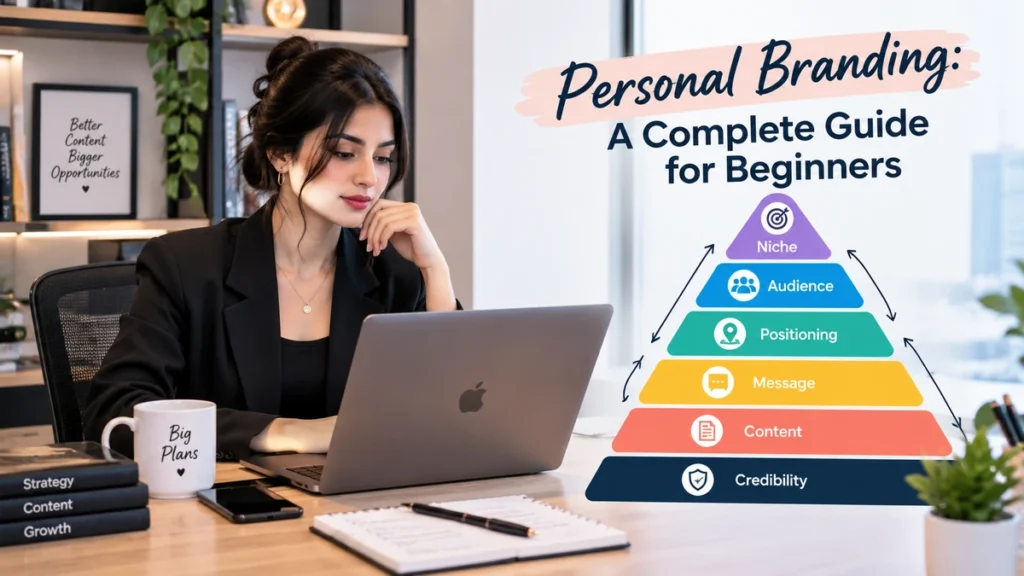
Personal branding is the deliberate practice of shaping how people perceive your skills, values, and expertise. It is why a freelancer gets recommended without pitching, a consultant gets invited to speak, and a designer’s name comes up when a client asks, “Who do you know for this?”
You already have a reputation, whether you manage it or not. Colleagues, clients, and search results are forming an opinion of you right now. Taking part in that process, instead of leaving it to chance, is what personal branding is about.
This guide to personal branding for beginners is written for freelancers, creators, professionals, consultants, and business owners. It shows you how to build a personal brand online step by step, with practical personal branding tips and no hype or guaranteed-results promises. Nobody can promise those, and anyone who does is selling something.
What Is Personal Branding?
Personal branding is the way you present your expertise, personality, and values so that the right people remember and trust you. It is built from what you say, what you publish, how you look online, and how you treat people.
A personal brand is the impression that results. Think of it as your professional reputation, made visible and consistent. HubSpot’s personal branding guide describes it in similar terms, as the result of consistent tone, positioning, and publishing.
A few realistic examples:
- A freelance copywriter who writes weekly breakdowns of landing pages and is known for SaaS onboarding copy.
- An accountant who explains tax basics to small-business owners on LinkedIn in plain language.
- A fitness coach who documents real client routines and shares what works for busy parents.
None of them is famous. Each is clearly known for something specific to a specific group of people. That is the core of personal brand identity.
Why Is Personal Branding Important?
People choose who to hire, follow, and recommend based on trust, and trust is easier to give to someone they can see and evaluate. The benefits below are possible outcomes, not guarantees. Results depend on your field, effort, and consistency.
Building credibility. A clear profile, real work samples, and consistent messaging make you look established rather than random.
Demonstrating expertise. Explaining how you solve problems shows your thinking. That is more convincing than listing skills.
Increasing online visibility. Publishing useful content and keeping profiles consistent makes you easier to find when people search for your name or topic.
Building trust. Trust comes from repeated, honest, helpful exposure. A reader who has learned something from you three times is warmer than a cold contact.
Creating professional opportunities. Referrals, speaking invitations, collaborations, and job leads often come from people who already know what you are good at.
Growing an audience. A focused brand gives people a reason to follow you and come back.
Supporting business growth. For business owners, a visible founder or expert can make marketing feel more human and lower the friction of a first conversation.
Personal Branding vs. Business Branding
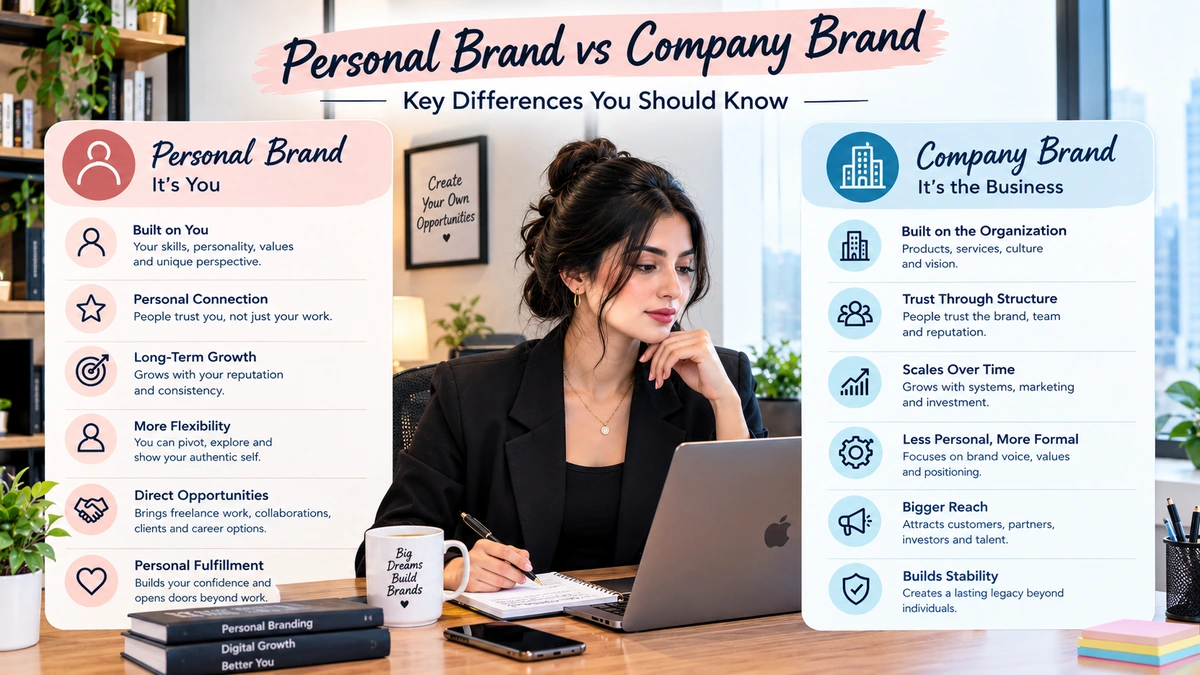
They overlap, but they are not the same thing. A business brand can outlive its founder. A personal brand travels with you.
| Aspect | Personal Branding | Business Branding |
|---|---|---|
| Centered on | One person’s expert voice, voice, and values | A company, product, or service |
| Tone | Individual, conversational | Often more formal or institutional |
| Trust comes from | The person’s experience and visibility | Reviews, reputation, consistency of service |
| Flexibility | Can pivot as the person grows | Changes more slowly |
| Risk | Depends heavily on one individual | Spread across a team or system |
| Best for | Freelancers, consultants, creators, founders | Companies, agencies, product businesses |
Many business owners benefit from both. A founder with strong personal branding can bring attention to the company, while the company brand gives customers something stable to rely on.
How to Build a Personal Brand Step by Step
If you have wondered how to build a personal brand from nothing, follow these twelve steps in order. Each builds on the last.
Step 1: Define What You Want to Be Known For
Write down the one sentence you want someone to say after meeting you. “She’s the person for B2B email copy” is stronger than “she does marketing.”
Step 2: Choose a Clear Niche
A niche is the overlap of what you know, what you enjoy, and what people need. Start narrow enough to be memorable. The next section shows how to do this without boxing yourself in.
Step 3: Identify Your Target Audience
Decide who you are speaking to. “Small business owners” is vague. Local service businesses with fewer than 20 employees” is usable.
Step 4: Understand Your Audience’s Problems
Read their questions in forums, comments, sales calls, and support emails. Use their words, not industry jargon. Notice which problems come up again and again, because those are your best content topics.
Step 5: Define Your Unique Positioning
Brand positioning is the space you occupy in someone’s mind compared with alternatives. Ask: what do I do, for whom, and how is my approach different? The difference can be method, experience, style, or focus. It does not need to be revolutionary. If you struggle to put it into words, this guide on how to write a value proposition statement walks you through it.
Step 6: Create Your Personal Brand Message
Turn your positioning into a short statement you can reuse on your website and in introductions. A formula is given below. To get several wording options quickly, you can run your draft through the Smart Text Generator and then rewrite the best version in your own voice.
Step 7: Create a Professional Online Profile
Start with one main profile, usually LinkedIn for professionals or a website for independents. Use a clear photo, a specific headline, and a summary that says who you help and how.
Step 8: Build a Consistent Visual Identity
Choose two or three colors, one or two fonts, and a consistent photo style. Consistency helps people recognize you across platforms. It also applies to words: pick one style for headlines and bios, and use a case converter to keep capitalization uniform. You do not need an expensive designer to begin.
Step 9: Create Valuable Content
Publish material that answers real questions. Quality and usefulness matter more than volume. The content section below covers formats.
Step 10: Build Credibility and Authority
Show proof: projects, results you can honestly report, client feedback you have permission to share, and appearances or mentions from others.
Step 11: Engage with Your Audience
Reply to comments, join conversations in your field, and ask questions. A personal brand is a relationship, not a broadcast.
Step 12: Measure and Improve Your Personal Branding
Review what is working every month. Double down on content and channels that bring the right people. Drop what does not.
How to Choose Your Personal Branding Niche
Beginners often fear that a personal branding niche is a cage. It is closer to a starting point. You can widen it later, but a vague brand is hard to start.
Try this process:
- List your skills and experience. Include past jobs, hobbies with real depth, and problems people ask you to solve.
- List the people you enjoy helping.
- Find the overlap where there is also demand. Search the topic, look for communities, and check whether people pay for help.
- Narrow by audience, problem, or method, not just topic.
Examples:
| Too broad | Better | Still flexible |
|---|---|---|
| “Marketing consultant” | “Email marketing for online course creators” | Can later add other creator tools |
| “Graphic designer” | “Brand identity for independent cafés” | Can expand to hospitality |
| “Career coach” | “Career changes for teachers moving into corporate roles” | Can grow to other public-sector careers |
If you are unsure, pick a working niche for six months. Treat it as a hypothesis and adjust based on the response you get.
How to Define Your Target Audience
Your target audience is the group of people you most want to help and who most benefit from your expertise. Describe them across five dimensions:
- Who they are: role, industry, experience level, business size.
- What problems they have: the frustrations, goals, and obstacles they name themselves.
- What they search for: the questions and phrases they type into Google. Keyword research tools can show related terms and question-style ideas around your topic.
- What platforms they use: where they actually spend time, whether LinkedIn, YouTube, Instagram, newsletters, or niche forums.
- What content they need: step-by-step tutorials, templates, honest comparisons, case studies, or quick tips.
Talk to five people in your target group if you can. Ten minutes of real conversation often beats hours of guessing.
How to Create a Personal Brand Statement
A personal branding statement is one or two sentences that explain who you help and how. Use this formula:
“I help [target audience] achieve [specific result] through [skill/service/expertise].”
Examples:
- “I help independent coffee shops attract regular customers through brand identity and packaging design.”
- “I help first-time managers run better team meetings through practical leadership coaching.”
- “I help B2B software companies explain complex products through clear website copy.”
- “I help home cooks with busy schedules eat well through 30-minute meal plans and video tutorials.”
Test it: say it out loud. If it sounds like a slogan and not like something you would say to a person, simplify it. If you offer a service, it also helps to pin down what sets you apart from competitors. Our article on how to write a USP for your small business shows how.
How to Build an Online Personal Brand
Online personal branding works best when you choose a few channels and do them well. You do not need to be active on every platform. Pick where your audience already is and where you can realistically be consistent.
Personal website. This is the one place you fully control. Include an about page, services or portfolio, contact details, and a blog or resources section. Tell visitors what to do next, and a CTA generator can give you clear button and link wording. Even a simple site beats none.
LinkedIn. Strong for professionals, consultants, B2B freelancers and job seekers. Optimize your headline, summary and featured section, then share useful posts.
Instagram. Works well for visual fields such as design, photography, fitness, food and lifestyle. Short educational carousels and behind-the-scenes posts suit it.
YouTube. Ideal for tutorials, demonstrations and longer explanations. It rewards patient, searchable content, and a YouTube tag generator can help you brainstorm tags for each video.
Other platforms. X, TikTok, Medium, Substack, GitHub, Behance or industry forums may fit certain professions better. If you want to test the waters before paying for hosting, you can start a free Blogger blog with just a Google account, then move to your own domain later.
A sensible beginner setup: one website or portfolio, one primary social platform, and one secondary channel if time allows.
Personal Branding Through Content
In personal branding, content is how strangers see your expertise before they meet you. Consistent, useful content shows how you think and solve problems. Over time it builds familiarity and trust. If you want to build the habit on a solid base, Copyblogger’s walkthrough on how to build a personal brand from scratch is a good companion read.
| Content type | Best for | Example |
|---|---|---|
| Blog posts | Search visibility, depth | “How I audit a landing page in 30 minutes” |
| Educational articles | Explaining concepts | “What makes a good brand voice?” |
| Social media posts | Regular presence, quick ideas | A three-tip LinkedIn post |
| Videos | Personality, demonstrations | A screen-share tutorial |
| Case studies | Proof of results | A project write-up with real outcomes |
| Tutorials | Practical help | “Set up your first email sequence” |
| Newsletters | Direct relationship | Weekly lessons from client work |
| Guides | Authority, lead capture | A downloadable checklist |
| Original insights | Thought leadership | Observations from your own experience |
Planning saves time. Before you write a post, sketch its structure first, and this blog post outline template for beginners gives you a simple starting point.
You also do not need to create everything from scratch each time. A blog post can become a video script, a carousel and three short posts.
Personal Branding and SEO
Personal branding and SEO support each other, but one does not guarantee the other. Publishing content and building a profile does not automatically produce Google rankings. What it does is create clearer, more useful signals about who you are and what you know.
- Search visibility. Content that answers real queries can bring people to you.
- Name searches. When someone searches your name, what appears? A website, a LinkedIn profile and a few relevant articles are a good baseline.
- Personal website. It gives search engines a central page connected to your name and topics.
- Author and About pages. Clear author details help readers judge who is behind the content. Google’s guidance on people-first content asks creators to consider who wrote the content, how it was made and why, which is exactly what a good author page answers.
- Relevant content. Focus on topics tied to your niche rather than everything at once.
- Internal linking. Link related articles so readers can follow the path.
- Profile consistency. Use the same name, photo, bio and links across platforms.
- Topical authority. Covering a subject thoroughly across several connected articles may help demonstrate depth.
When you write these articles, clear titles and natural keyword use matter. Avoid stuffing phrases into every sentence.
Personal Branding in the Age of AI
AI can speed up personal branding work, but it cannot supply your experience.
Where AI helps:
- Brainstorming angles and topics.
- Content ideas based on questions your audience asks.
- Outlines you then rework.
- Repurposing a long article into shorter posts.
- Editing for clarity and grammar. A filler word checker is a quick way to tighten a draft.
Where you still matter most:
- Real experience. AI has not worked with your clients.
- Original insights. Your opinions and lessons are what make you different.
- Fact-checking. AI can state wrong things confidently. Verify anything factual.
- Voice. Generic text makes many brands sound alike.
Google’s own advice for the AI era points the same way: focus on unique, valuable content for people. Beyond that, be careful with anyone who claims to know exactly how AI systems choose sources, since those details are not fully public.
How to Build Credibility
Credibility is the foundation of personal branding: it is the reason someone believes you. It is earned through evidence, not adjectives. Never invent credentials, testimonials or results. One exaggerated claim can undo years of work.
- Demonstrate expertise. Explain your process, show your reasoning and admit trade-offs.
- Portfolio and examples. Show real work, with permission where needed.
- Case studies. Describe the problem, what you did and what happened, including limits or context.
- Testimonials, where genuine. Ask permission and use the person’s actual words.
- Professional profiles. Keep LinkedIn and other profiles current and accurate.
- Author information. Put your name, role and short bio on articles.
- External mentions. Guest posts, podcasts, interviews and citations from others carry weight because someone else vouches for you.
- Consistent useful content. Steady publishing shows you are engaged with your field.
No portfolio yet? Do a small project for a nonprofit or a personal case study, and label it honestly.
Common Personal Branding Mistakes
These are the mistakes that most often slow down a beginner’s personal branding efforts.
- Trying to appeal to everyone. A message for everybody lands with nobody.
- Copying other creators. Learn from them, but use your own experience and voice.
- Inconsistent messaging. If your website, LinkedIn and Instagram say different things, people are confused.
- Posting without a strategy. Random posts rarely add up to a clear reputation.
- Focusing only on followers. Ten right people are worth more than ten thousand irrelevant ones.
- Overpromoting. If every post is a pitch, people tune out. Mix help with offers.
- Using generic AI content. Unedited AI text is easy to spot and easy to forget.
- Ignoring audience needs. Talking only about yourself leaves readers with no reason to return.
- Changing niche constantly. Give a direction at least a few months before judging it.
- Neglecting credibility. No proof, no bio and no examples make trust harder.
- Being everywhere at once. Spreading thin leads to burnout. Do fewer channels well.
- Overclaiming. Calling yourself an “expert” or “top” without evidence damages trust.
Personal Branding Content Ideas
Here are 24 practical ideas for personal branding content, grouped by purpose.
Educational
- A beginner’s glossary of terms in your field.
- “5 mistakes I see beginners make in [topic].”
- A step-by-step tutorial for a common task.
- A checklist people can print.
Personal experience
- How you started in your field.
- A mistake you made and what it taught you.
- What you would tell your first-year self.
- A turning point in your work.
Expertise
- Your process for solving a typical client problem.
- A tool comparison based on your own use.
- A breakdown of a good (or bad) example in your industry.
Behind-the-scenes
- A day in your workflow.
- How you prepare for a project.
- Your tools, templates and routines.
Case studies
- A project write-up: problem, approach, result.
- A before-and-after example, with permission.
- Lessons from a project that did not go as planned.
Opinion / thought leadership
- A myth in your industry you disagree with.
- A prediction, clearly marked as opinion.
- Your view on a trend, with reasons.
FAQ content
- Answer the five questions clients ask most.
- “Is [tool or method] worth it?”
- “How much time does [task] really take?”
- A Q&A post based on audience comments.
30-Day Personal Branding Action Plan
This simple personal branding strategy assumes about 30–60 minutes a day. Adjust it to your schedule.
| Day / Week | Task | Purpose | Expected output |
|---|---|---|---|
| Days 1–2 | Write down your skills, experience and interests | Clarify what you offer | A one-page skills list |
| Days 3–4 | Choose a working niche and audience | Focus your message | A niche and audience description |
| Day 5 | Research five audience questions in forums or comments | Understand real problems | A list of audience questions |
| Days 6–7 | Draft your brand statement | Create a reusable message | One clear brand statement |
| Week 2, Day 8 | Update your LinkedIn headline and summary | Align your profile | Updated profile |
| Week 2, Day 9 | Choose colors, fonts and a profile photo | Build visual consistency | A simple style guide |
| Week 2, Days 10–11 | Set up a basic website or portfolio page | Create a central hub | A live About and Contact page |
| Week 2, Days 12–14 | Collect work samples and any genuine feedback | Build proof | A portfolio draft |
| Week 3, Day 15 | Plan four content topics | Create direction | A four-week content list |
| Week 3, Days 16–18 | Write and publish your first article or post | Start showing expertise | One published piece |
| Week 3, Days 19–20 | Repurpose it into two short posts | Extend reach | Two social posts |
| Week 3, Day 21 | Comment thoughtfully on 10 posts in your field | Start relationships | Ten meaningful comments |
| Week 4, Days 22–24 | Publish a second useful piece | Build consistency | A second published piece |
| Week 4, Day 25 | Reach out to three peers or past clients | Widen your network | Three conversations started |
| Week 4, Days 26–27 | Review views, replies and profile visits | Learn what resonates | A simple results note |
| Week 4, Days 28–30 | Adjust your plan for the next 30 days | Improve | A refined content calendar |
[IMAGE 4: 30-day infographic]
How to Measure Personal Branding Progress
The right personal branding metrics depend on your goal. A freelancer wants inquiries. A creator may care about subscribers. A job seeker may care about recruiter messages. Choose two or three metrics, not all of them.
| Metric | What it tells you | Where to check |
|---|---|---|
| Website traffic | Whether people are finding your content | Google Analytics |
| Profile visits | Interest in you as a person | LinkedIn and platform analytics |
| Search impressions | How often you appear in search | Google Search Console |
| Content engagement | Whether content is useful (saves, comments, shares) | Platform analytics |
| Email subscribers | Growth of a direct audience | Email platform |
| Inbound inquiries | Real business interest | Your inbox and forms |
| Mentions | Recognition from others | Manual search or alerts |
| Relevant connections | Network quality, not just size | Your own review |
Numbers alone can mislead. Ten inquiries from the wrong audience are less useful than two from ideal clients. Review monthly and compare against your own past results, not other people’s.
Frequently Asked Questions
What is personal branding?
It is the practice of deliberately shaping how others see your expertise, values and professional reputation, so the right people remember and trust you.
How do beginners build a personal brand?
Start by defining what you want to be known for, choose a niche and audience, set up one strong profile, and publish useful content regularly. Add proof and engage with people over time.
How long does personal branding take?
There is no fixed timeline. Many people notice early signs, such as more profile visits or replies, within a few months of steady effort, but it varies by field, consistency and audience.
Is a personal website necessary?
Not strictly, but it is helpful. A website gives you full control over your message and portfolio, and it supports search visibility. LinkedIn alone can work at the start.
Which social media platform is best for personal branding?
It depends on your audience. LinkedIn suits many professionals and B2B services, Instagram suits visual work, and YouTube suits tutorials. Pick the one your audience uses.
Can personal branding help freelancers?
Yes. Clear positioning and visible proof make it easier for clients to understand your services and trust you. It does not guarantee work, but it usually makes your outreach and referrals stronger.
Can AI be used for personal branding?
Yes, for brainstorming, outlines, repurposing and editing. Keep your real experience, original insights and fact-checking at the center so the result sounds like you.
How often should you publish content?
Choose a schedule you can maintain, such as one article and two short posts a week. Consistency matters more than volume.
Key Takeaways
- Personal branding is your reputation, built on purpose, and it starts with a clear niche and a specific audience.
- Use the formula: “I help [audience] achieve [result] through [expertise].”
- Choose one or two platforms rather than all of them.
- Useful, consistent content demonstrates expertise better than claims.
- SEO supports personal branding but does not guarantee rankings.
- Use AI to save time, not to replace your experience.
- Never invent credentials, testimonials or results.
- Measure progress against your own goals.
Conclusion
You do not need a big following to start personal branding. You need a clear focus, a few honest examples of your work, and the patience to show up consistently.
Your next step: open a blank document today and write your one-sentence brand statement using the formula above. Then update your main profile to match it. That small action starts everything else.

- I’m Saba Sheikh, a self-employed copywriter and SEO content writer specializing in website copy, landing pages, SEO blog writing, product descriptions, and email copywriting. I create search-optimized, conversion-focused content that helps startups, small businesses, and eCommerce brands grow their online presence and attract more customers.