This guide explains how to write a press release that Australian journalists will actually read.Journalists in Australia receive a large number of emails every day. Most of them are deleted in seconds. A well-written press release gives your story a real chance, because it makes the journalist’s job easy: it is clear, short, newsworthy and ready to use.
This guide shows you how to write a press release in 7 simple steps, with a template, a made-up Melbourne example and a plain-English summary of the rules for Australian businesses. Everything is written with Australia in mind, including spelling, local examples and where to send your release. All businesses in the examples are illustrative.
What Is a Press Release?
A press release is a short, factual announcement that a business sends to journalists and editors. It tells them something new and gives them everything they need to write a story. In Australia, many people call it a media release. The two terms mean the same thing, so this guide uses both.
A press release is not an advertisement. It does not sell a product. It shares news: a launch, an award, a partnership, a local event or a new study. If you are new to professional writing, our guide to SEO copywriting vs content writing explains how different types of writing serve different goals.
Once you understand the purpose, learning how to write a press release becomes much easier.
Why Press Releases Still Matter in Australia
Australia has national outlets, state newspapers, regional papers, radio, trade magazines and many online news sites. For a small business in Brisbane, Perth or Hobart, local and industry media can bring credibility that advertising cannot buy. A press release also gives you a clean, shareable page for your own website and social media.
A press release works best as one part of a wider plan. Our content marketing strategy guide shows how announcements, blogs and email fit together.
That is why every small business should know how to write a press release for local media.
What Counts as News? (Table 1)
Before you learn how to write a press release, check that you have news. If not, journalists will not use it.
| Good press release topic | Weak press release topic |
|---|---|
| Opening a second Sydney store | “We have a new logo” |
| Winning a state business award | “We are the best in our industry” |
| Launching a new service for local families | A routine sale or discount |
| Publishing original local research | Opinion with no facts |
| Hiring 10 local staff in a regional town | An ordinary staff birthday |
A simple test: would someone who does not know your business care? If the answer is no, find a stronger angle or skip the release.Before you decide how to write a press release, confirm that your story is truly new.
How to Write a Press Release in 7 Steps
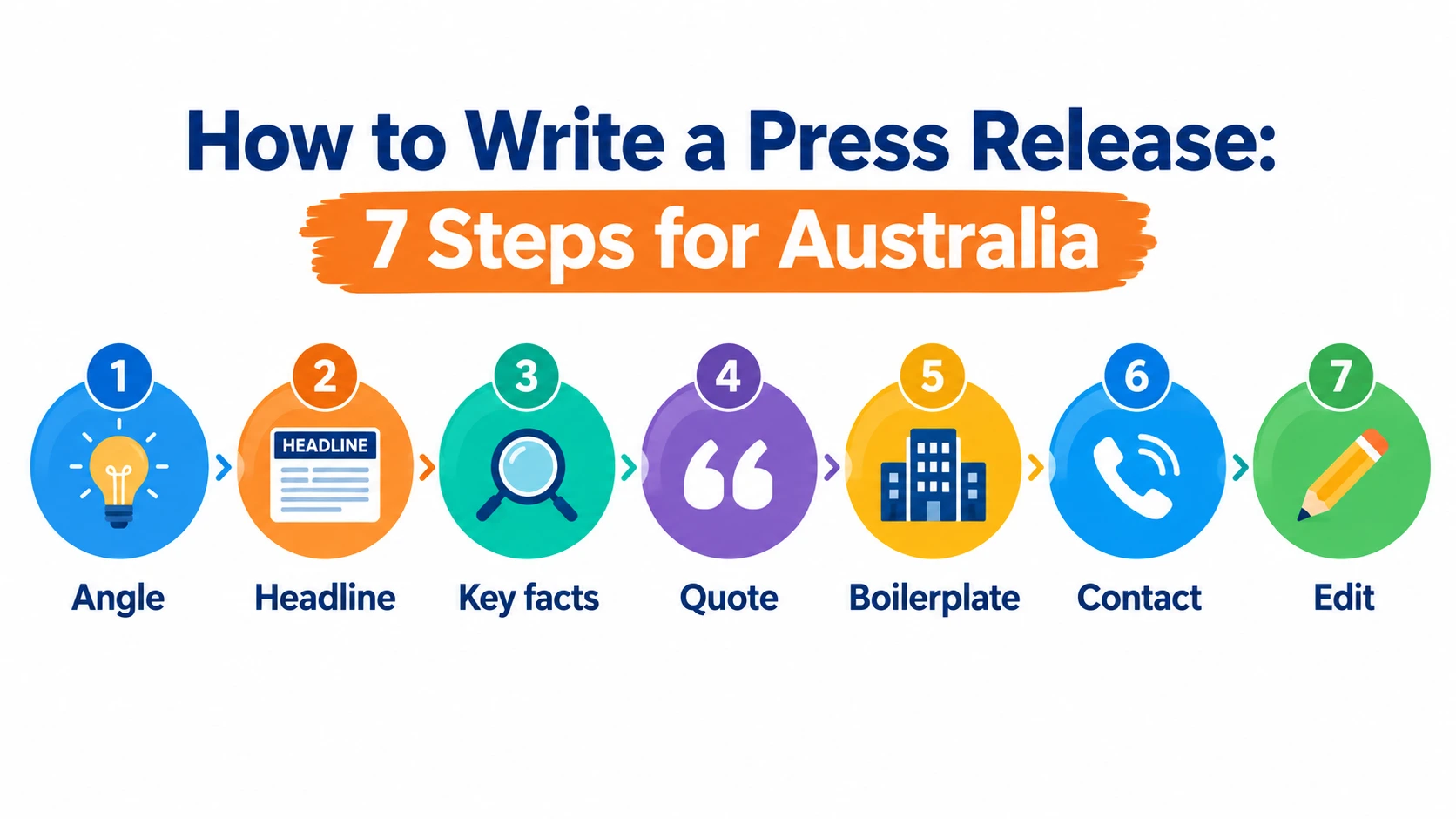
Step 1: Find the News Angle
Follow these seven steps to see how to write a press release from start to finish.Ask: what is new, who does it help and why now? Local angles work well in Australia. A story about “20 new jobs in Ballarat” is more useful to a Victorian journalist than a general company update.
Step 2: Write a Strong Headline
The headline is the most important line. Keep it short, specific and factual. Put the key words first, and avoid hype like “revolutionary” or “world-class”.
- Weak: “Exciting news from Harbourline Coffee”
- Strong: “Melbourne Roaster Opens Second Café and Hires 12 Local Staff”
Test several versions with our headline analyzer.
Step 3: Open With the Key Facts
The first paragraph answers who, what, when, where and why. Journalists should understand your news from this paragraph alone. Include the city and date near the start, in the style of “MELBOURNE, 24 October 2026”.
This opening paragraph is the most important part of how to write a press release.
Step 4: Add Support and a Quote
The second and third paragraphs add detail, numbers and one quote from a real person in your business. A good quote adds opinion or emotion, not repeated facts. Use only quotes that the person has really said and approved.
Step 5: Write a Short Boilerplate
The boilerplate is a two or three sentence paragraph about your organisation. It explains who you are, what you do and where you operate. Keep it the same across all releases, and update it when something changes.
Step 6: Add Media Contact Details
Give a name, phone number (in Australian format, such as +61 3 0000 0000), email address and website. Journalists work to tight deadlines, so make it easy to reach you. If you have photos, say they are available and link to a download page.
Step 7: Edit Like a Journalist
Cut every word that does not help. Use short sentences, active voice and plain words. Check these before you send:
- Names, dates, numbers and spelling are correct.
- Australian spelling is used (organisation, programme becomes program, colour).
- The release is usually one page, which is roughly 300 to 500 words.
Use our passive voice checker to catch weak sentences and our readability checker to keep the language simple.Careful editing is the final step in how to write a press release that gets noticed.
Press Release Format and Template
The standard press release format is simple, and you can copy it for every announcement.
FOR IMMEDIATE RELEASE
[Date: 24 October 2026]

[HEADLINE: Short, specific, factual]

[CITY, DATE] – [First paragraph: who, what, when, where, why.]

[Second paragraph: more detail, numbers and context.]

"[Quote from a named person with their title.]" said [Name], [Title] at [Organisation].

[Third paragraph: how it helps local people or customers.]

About [Organisation]
[Two to three sentence boilerplate.]

Media contact
[Name] | [Phone] | [Email] | [Website]

###
Use “FOR IMMEDIATE RELEASE” if the news can be published now. If you want journalists to wait, write “EMBARGOED UNTIL” and give a date and time, and use embargoes only when you really need them. The three hash symbols at the end are a traditional sign that the release is finished.
Press Release Example for an Australian Business
This is an original, made-up example. The business, people and details are not real.
FOR IMMEDIATE RELEASE
24 October 2026Melbourne Roaster Opens Second Café and Hires 12 Local Staff
MELBOURNE, 24 October 2026 – Harbourline Coffee Roasters will open its second café in Footscray on 14 November, creating 12 new jobs for local residents.
The new site seats 40 people and will serve coffee roasted at the company’s Brunswick workshop. The business says it will train staff in roasting and barista skills, with places reserved for people living within five kilometres.
“We started with one small counter and a lot of curiosity,” said Sam Nguyen, founder of Harbourline. “Footscray gave us our first customers, so it feels right to grow there.”
About Harbourline Coffee Roasters
Harbourline Coffee Roasters is a Melbourne-based roaster and café group founded in 2019. It supplies beans to local offices and restaurants.Media contact: Priya Shah | +61 3 0000 0000 | media@example.com.au
Why this works: it has a local angle (Footscray jobs), a clear headline, the key facts first, one human quote and an easy contact.
Do and Don’t Checklist (Table 2)
| Do | Don’t |
|---|---|
| Lead with the news | Start with company history |
| Use facts, dates and numbers | Use vague claims like “best in Australia” |
| Write in the third person | Write “we” and “our” in the body |
| Keep it to one page | Send a five-page document |
| Offer photos and an interview | Attach large files to the first email |
| Check every fact twice | Guess at figures |
Common Mistakes When Writing a Press Release
Many beginners make the same errors when they learn how to write a press release.
- Sending an advert instead of news.
- Burying the main point in paragraph four.
- Using jargon, slang or buzzwords.
- Writing the same release for every outlet with no local angle.
- Forgetting a media contact.
- Making claims you cannot prove.
Where to Send Your Media Release in Australia
Knowing how to write a press release is only half the job, since you must also send it to the right person.
Send your release to the right person, not a general inbox. Start with:
- Local and regional newspapers in your town or city.
- Industry and trade publications that cover your field.
- Community radio and local online news sites.
- Journalists who have written about similar stories. Read their recent work first.
Write a short, personal email, paste the release into the body and attach nothing large. Follow up once after a few days, politely, and then let it go. You can also publish the release on your own website as a news post, which helps your own SEO. Pick a clear title and description for that page with our meta description generator.
Rules to Keep in Mind in Australia
Every claim in a press release must be true. In Australia, the Australian Competition and Consumer Commission (ACCC) explains the rules for advertising and selling under the Australian Consumer Law, including not misleading customers. Keep proof for any statistic, award or comparison. Journalists also work under professional standards, and the Australian Press Council publishes standards on accuracy and fairness that show what newsrooms expect.
This is general information, not legal advice. Ask a qualified professional about your own situation.
Plan Your Release Before You Write
A short brief saves time. List the news, the audience, the quote, the numbers and the call to action before you write a single sentence. Our content brief template works well for this. Reading on screens is mostly scanning, so Nielsen Norman Group is a useful read on writing short, clear text.

After You Publish: Make the Release Work for SEO
Put the release on your site as a normal page, with a clear title, a short URL and links to related pages. Keep the headline honest and the content original, in line with Google’s helpful content guidance. Research the phrases your audience uses with our guide on how to find relevant SEO keywords.
FAQ
How do you write a press release?
Find a real news angle, write a clear headline, put the key facts in the first paragraph, add a quote and a boilerplate, then finish with media contact details.
What is the difference between a press release and a media release in Australia?
There is no real difference. “Media release” is a common term in Australia, while “press release” is used widely online.
How long should a press release be?
Usually one page, about 300 to 500 words. Shorter is better if the news is simple.
What is the correct press release format?
Start with “For immediate release” and the date, then the headline, the opening paragraph, supporting details, a quote, a boilerplate, contact details and the ending mark (###).
How do I send a press release to Australian media?
Email it to the right journalist or editor, paste it into the email body, keep the subject line clear and offer photos or an interview.
Do I have to pay to publish a press release in Australia?
Not to send it to journalists directly. Paid distribution services exist, but they are optional, and there is no guarantee that anyone will publish your story.
Can a small business write its own press release?
Yes. If you have real news, a clear format and honest facts, a small business can write a good release without an agency.
Conclusion
Learning how to write a press release comes down to a few habits: find real news, lead with the key facts, keep it short and make it easy for journalists to reach you. Use the template and checklist above, give every release a local angle for your Australian audience and keep every claim honest. If you want help with press releases, blogs or web copy for your Australian business, contact us.

- I’m Saba Sheikh, a self-employed copywriter and SEO content writer specializing in website copy, landing pages, SEO blog writing, product descriptions, and email copywriting. I create search-optimized, conversion-focused content that helps startups, small businesses, and eCommerce brands grow their online presence and attract more customers.