Learning how to reduce passive voice in writing doesn’t mean memorizing a grammar rule. You need one repeatable test you can run on any sentence in about three seconds, then a small set of fixes depending on what that test reveals. This guide covers how to reduce passive voice in writing using exactly that approach, common in business writing across the US, UK, Australia, and Canada, where clear, direct copy consistently outperforms formal, indirect phrasing.
Government style guides in both the US and UK back this up directly. The US government’s plain language guidelines recommend active voice as a default for public-facing writing, and the UK government’s own content design standards go further, treating passive voice as one of the most common reasons official writing feels unclear to ordinary readers. If government agencies are prioritizing this fix, it’s worth taking seriously in business writing too.
Run This One Test on Any Sentence
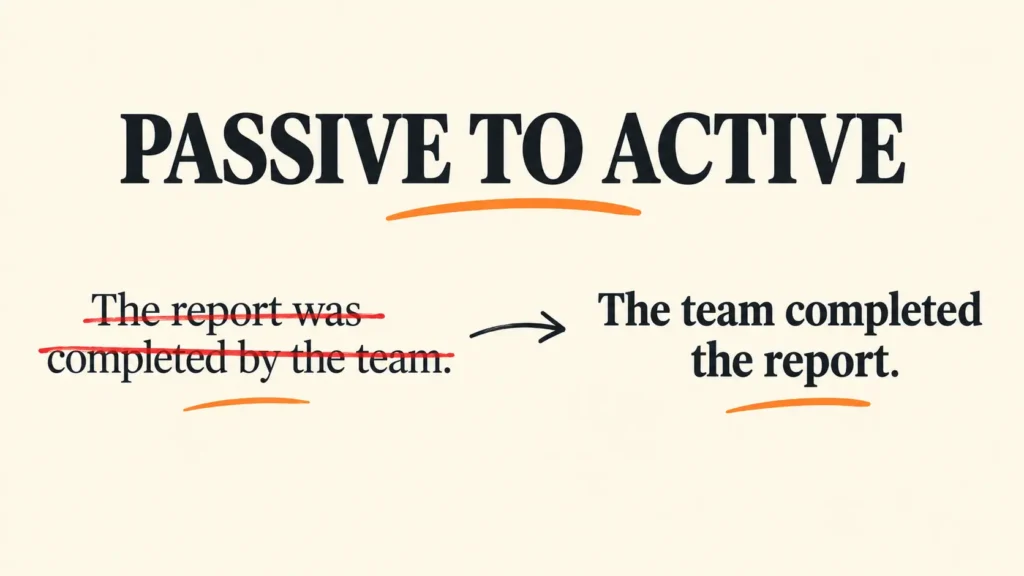
Read the sentence and ask, “Who or what is doing the action?” If the doer shows up after the verb or doesn’t show up at all, the sentence is passive. “The report was completed by the team” fails this test, the team (the doer) is buried at the end. “The team completed the report” passes, the doer leads. Once you’ve internalized how to reduce passive voice in writing using just this one question, most of the fixes below become almost automatic.
This single test replaces the need to memorize technical grammar terms. Once you can spot the pattern, learning how to reduce passive voice in writing becomes a matter of applying one of the five fixes below. Grammarly’s guide to active versus passive voice uses a similar doer-first test, which suggests this approach holds up as a genuinely reliable shortcut, not just a personal preference.
Fix One: Find the Real Doer
Passive: “Mistakes were made during the onboarding process.” Active: “Our support team made mistakes during onboarding.”
The passive version hides who’s responsible, sometimes intentionally in a corporate apology, but usually just out of habit. If you want to know how to reduce passive voice in writing, start here: finding the real doer and moving them to the front of the sentence is the single most reliable fix, and it’s worth mastering before moving to the other four.
Fix Two: Swap the Verb Order
Passive: “Your invoice has been sent to your billing email.” Active: “We sent your invoice to your billing email.”
Notice the verb itself barely changes; “has been sent” becomes “sent.” The real fix is verb order: doer, then verb, then object. This is often the fastest fix to apply once you’ve spotted the pattern.
Fix Three: Cut the “By” Phrase Entirely
Passive: “The proposal was reviewed by our legal team before approval.” Active: “Our legal team reviewed the proposal before approval.”
Any sentence with a “by [someone]” phrase near the end is almost always passive, and the fix is simply moving that “by” phrase to the front and dropping “by.”
Fix Four: Watch for Hidden Passive in Headlines
Headlines and subject lines hide passive voice more often than body copy, because shorter sentences make the pattern less obvious. “New Features Announced” is passive; “We’re Announcing New Features” or better, “See What’s New” is active and reads with more energy.
Our free Passive Voice Checker catches this specific pattern automatically, since headline passive voice is easy to miss when scanning quickly.
Fix Five: Don’t Fix What Isn’t Broken
Passive voice isn’t grammatically wrong, and forcing every sentence into active voice can sound unnatural. “The bridge was built in 1932” is a reasonable passive sentence, the builder isn’t the point, the date is. Learning how to reduce passive voice in writing means reducing overuse, not eliminating the construction entirely, and recognizing this distinction is what separates a natural-sounding edit from an over-corrected one.
According to the Purdue Online Writing Lab’s guidance on active and passive voice, passive voice remains appropriate when the actor is unknown, unimportant, or deliberately being de-emphasized, which is a normal and legitimate part of clear writing, not always a mistake to correct.
Quick Reference Table
| Passive Signal | Quick Fix | Example |
| “was/were + past participle” | Move the doer to the front | “was written by the team” → “the team wrote” |
| “has been + past participle” | Swap verb order | “has been sent” → “we sent” |
| “by [someone]” near the end | Cut “by,” move name forward | “reviewed by legal” → “legal reviewed” |
| Passive headline | Rewrite as a direct statement | “Changes Announced” → “See What Changed” |
| Passive with unknown actor | Leave as-is | “Windows are cleaned weekly” (fine) |
For a broader look at tightening business writing beyond passive voice specifically, the Filler Word Checker and Word Counter both help catch related issues, wordiness and padding, that often show up in the same sentences as heavy passive construction. If you’re still building the foundational writing skills this fix assumes, the Copywriting Guide for Beginners covers direct, clear sentence structure as one of its core lessons, and the Website Copywriting Checklist for Small Business includes a specific check for passive, company-focused language on homepage and About page copy.
FAQs
Is passive voice grammatically incorrect?
No. It’s a legitimate grammatical construction. The concern is overuse, not correctness, since heavy passive voice tends to read as indirect and less confident.
What percentage of passive voice is too much?
As a general guide, business and marketing copy above roughly 10 to 15% passive sentences often starts to feel noticeably indirect, though this varies by document type and audience.
Does Microsoft Word or Google Docs flag passive voice automatically?
Both tools include grammar checkers that can flag passive constructions, though a dedicated checker built specifically around business and marketing writing tends to give more relevant, context-aware suggestions.
Should academic writing avoid passive voice too?
Not necessarily. When learning how to reduce passive voice in writing, context matters: academic and scientific writing traditionally uses more passive voice than marketing copy, so a higher passive percentage is often appropriate and expected in that context.
Does how to reduce passive voice in writing differ between US and UK English?
The underlying grammar is identical, but UK government and business writing guidance tends to emphasize active voice just as strongly as US equivalents, so the same fixes apply regardless of which regional style guide you’re following.
Why does passive voice matter more in headlines and CTAs?
Headlines and calls to action have very little space to work with, so a passive construction there wastes proportionally more of the reader’s attention than the same pattern buried in a longer paragraph.
Is there a quick way to test a whole page at once rather than sentence by sentence?
Yes, running the full page through a dedicated checker is faster than manually testing each sentence, especially on longer pages like a homepage or full blog post where passive voice can hide in places you’d naturally skim past while proofreading. This is usually the most efficient version of how to reduce passive voice in writing across an entire site rather than one document at a time.
Conclusion
Learning how to reduce passive voice in writing doesn’t require memorizing grammar terminology. Run the three-second doer test on any sentence that feels sluggish, apply whichever of the five fixes above matches the pattern, and leave the occasional legitimate passive sentence alone rather than forcing every single sentence into an awkward active rewrite.

- I’m Saba Sheikh, a self-employed copywriter and SEO content writer specializing in website copy, landing pages, SEO blog writing, product descriptions, and email copywriting. I create search-optimized, conversion-focused content that helps startups, small businesses, and eCommerce brands grow their online presence and attract more customers.